
 United States (USD)
 Singapore (SGD)
 Thailand (THB)
 Australia (AUD)
 Canada (USD)
 Egypt (USD)
 European Country (EUR)
 Hong Kong (HKD)
 India (USD)
 Indonesia (IDR)
 Iran (USD)
 Iraq (USD)
 Japan (JPY)
 Myanmar (USD)
 Oman (USD)
 Qatar (USD)
 Saudi Arabia (USD)
 Switzerland (CHF)
 Taiwan (USD)
 Turkey (USD)
 UAE (USD)
 United Kingdom (GBP)
 International (USD)
Rated 4.98-stars across 3.9K+ reviews


 By
By
Why do some diseases skip a generation then reappear? The answer is dominant and recessive genes. Understand the basics of genetics, what a "carrier" means, and why it matters for reading gene tests and family planning.
Why do some children have dark eyes when some parents have light eyes? Why do some diseases skip a generation and reappear? The answer lies in the most fundamental principle of genetics: dominant and recessive genes. This article explains it simply, with its meaning for health.
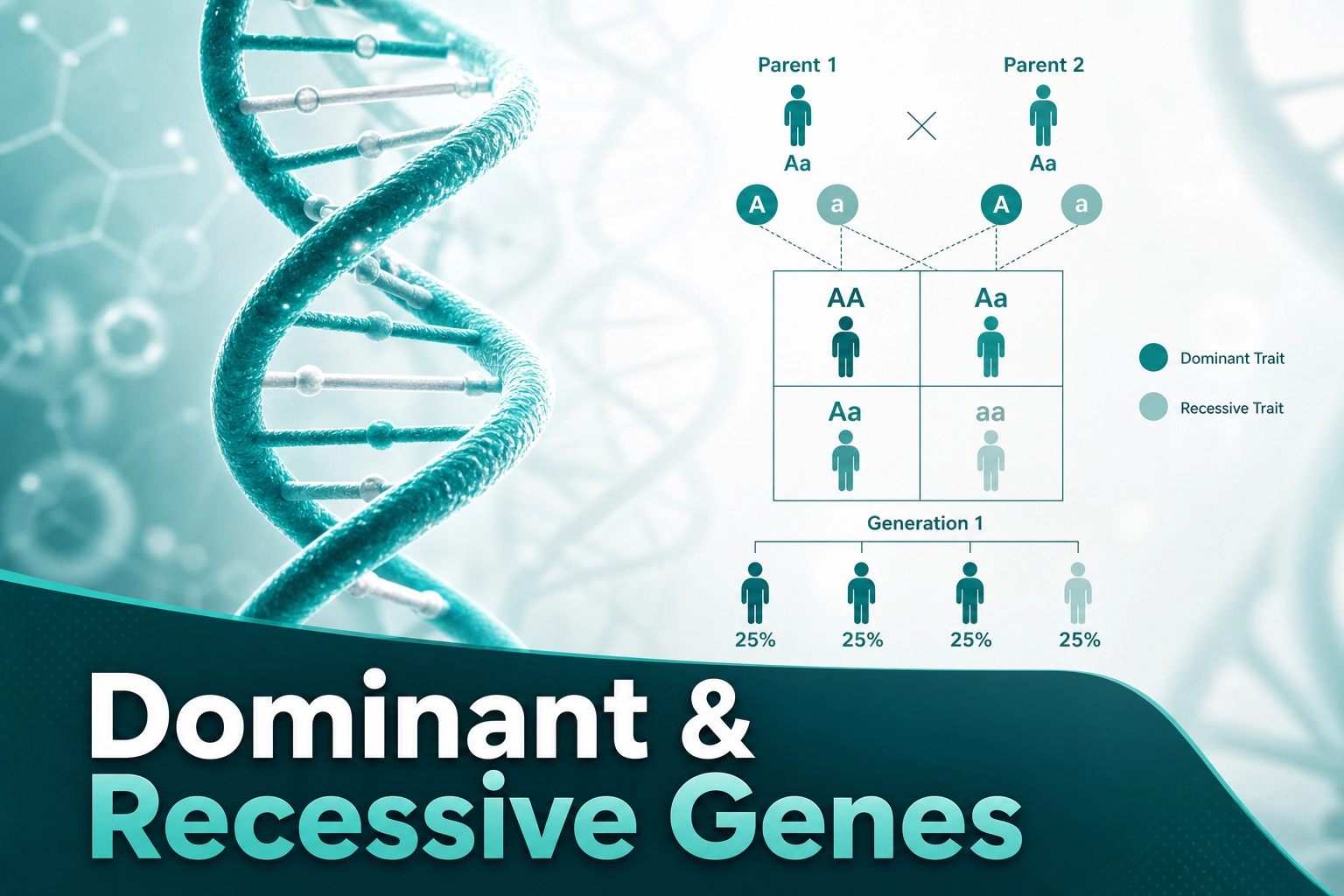
Humans have chromosomes in pairs, so each gene position has two copies — one from the mother, one from the father. Different forms of a gene are called "alleles." Whether a trait shows up depends on whether the alleles you inherited act dominantly or recessively.
A dominant gene is an allele that shows its trait even with just one copy, while a recessive gene is expressed only when both copies are present. Classic examples include certain hair or taste traits — and importantly, many genetic diseases are inherited recessively.
Someone with just one copy of a disease-causing recessive gene is called a "carrier." They usually show no symptoms because the other normal copy still works, but they can pass the recessive gene to their children. If both parents are carriers, the child has a 25% chance of inheriting two copies and getting the disease. This is why carrier screening before having children matters. It connects with the lactose intolerance gene, which is recessive.
Understanding dominant and recessive genes helps you read DNA test results correctly, especially distinguishing "being a carrier" from "having the disease" — which mean very different things. It also helps with family planning and assessing risk in the next generation with real data. This aligns with DNA analysis.
The dominant-recessive principle is the "ABC" of genetics. Once you understand it, complex topics like genetic disease risk become much clearer. Gene testing helps you learn what you're a carrier of — valuable information for family health planning. Start with a DNA test.
1. What's the difference between a dominant and a recessive gene?
A dominant allele shows its trait with just one copy, while a recessive allele needs two copies (one from each parent) to be expressed.
2. Is being a carrier the same as having the disease?
No — a carrier has one recessive copy and shows no symptoms, while an affected person has two. Reading a genetic result means telling these apart clearly.
3. If both parents are carriers, will the child definitely have the disease?
Not necessarily — there's about a 25% chance the child inherits two recessive copies and is affected. Carrier screening helps with planning.

