


 United States (USD)
 Singapore (SGD)
 Thailand (THB)
 African Country (USD)
 Australia (AUD)
 Canada (USD)
 Egypt (USD)
 European Country (EUR)
 Hong Kong (HKD)
 India (USD)
 Iran (USD)
 Iraq (USD)
 Japan (JPY)
 Myanmar (USD)
 Oman (USD)
 Qatar (USD)
 Saudi Arabia (USD)
 Switzerland (CHF)
 Taiwan (USD)
 Turkey (USD)
 UAE (USD)
 United Kingdom (GBP)
 International (USD)
Rated 4.98-stars across 3.9K+ reviews


 By
By
Our cells hold DNA in two places, and one set in the mitochondria travels only through the maternal line. Learn how mtDNA traces maternal ancestry and connects us to Mitochondrial Eve, a common mother of humanity.
Our cells contain DNA in two places — not just the nucleus, but also the mitochondria, the cell's powerhouse. And this DNA has a special story, because it travels only through the maternal line. This article explores what mtDNA can tell us about our ancestry.
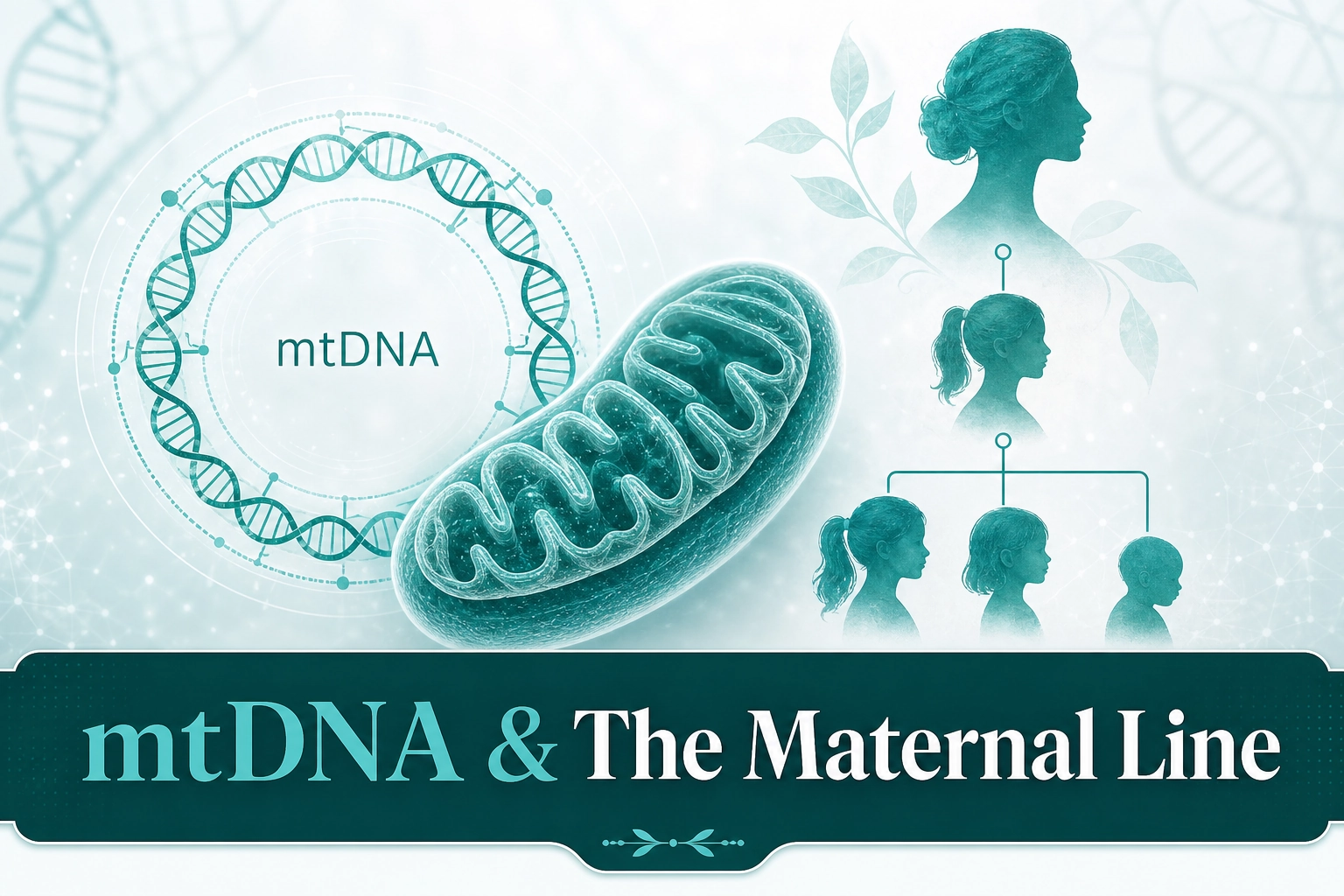
Mitochondria are organelles that produce energy for cells, and they have their own small circular DNA separate from nuclear DNA. mtDNA is much smaller but special: it's passed almost entirely from mother to child, because the mother's egg contains many mitochondria while the father's are barely transmitted.
Because mtDNA passes through the maternal line and changes slowly, comparing mtDNA across groups reveals maternal blood relationships reaching far back. Geneticists group mtDNA into "haplogroups," which indicate which region of the world your maternal line came from. This connects with ancestry DNA analysis.
Tracing the mtDNA of humans worldwide back, scientists found all lines converge on a single woman in Africa hundreds of thousands of years ago, called "Mitochondrial Eve." It doesn't mean she was the only woman of her time, but the one whose mtDNA line carries down to everyone today. It's a key piece of evidence in theories of human origins.
Beyond ancestry, mtDNA is also important for cellular energy production. Mutations at certain positions are linked to genetic diseases inherited through the maternal line, such as some muscle and nervous-system disorders. Studying mtDNA therefore has value for both genealogy and medicine.
mtDNA is like a "logbook of the maternal line" passed down generation to generation almost unchanged. Studying it not only tells the story of our ancestors but connects us to the history of all humanity. If you want to know where your bloodline came from, start with a DNA test.
1. How is mtDNA different from nuclear DNA?
mtDNA is a small circular genome inside mitochondria, inherited only from the mother, while nuclear DNA comes from both parents.
2. Do men have mtDNA?
Yes — men carry mtDNA inherited from their mother, but they can't pass it on, so mtDNA traces only the maternal line.
3. Was Mitochondrial Eve the only woman of her time?
No — she's simply the woman whose mtDNA line reaches everyone alive today. Many other women lived then, but their mtDNA lines didn't survive.

