


 United States (USD)
 Singapore (SGD)
 Thailand (THB)
 African Country (USD)
 Australia (AUD)
 Canada (USD)
 Egypt (USD)
 European Country (EUR)
 Hong Kong (HKD)
 India (USD)
 Iran (USD)
 Iraq (USD)
 Japan (JPY)
 Myanmar (USD)
 Oman (USD)
 Qatar (USD)
 Saudi Arabia (USD)
 Switzerland (CHF)
 Taiwan (USD)
 Turkey (USD)
 UAE (USD)
 United Kingdom (GBP)
 International (USD)
Rated 4.98-stars across 3.9K+ reviews


 By
By
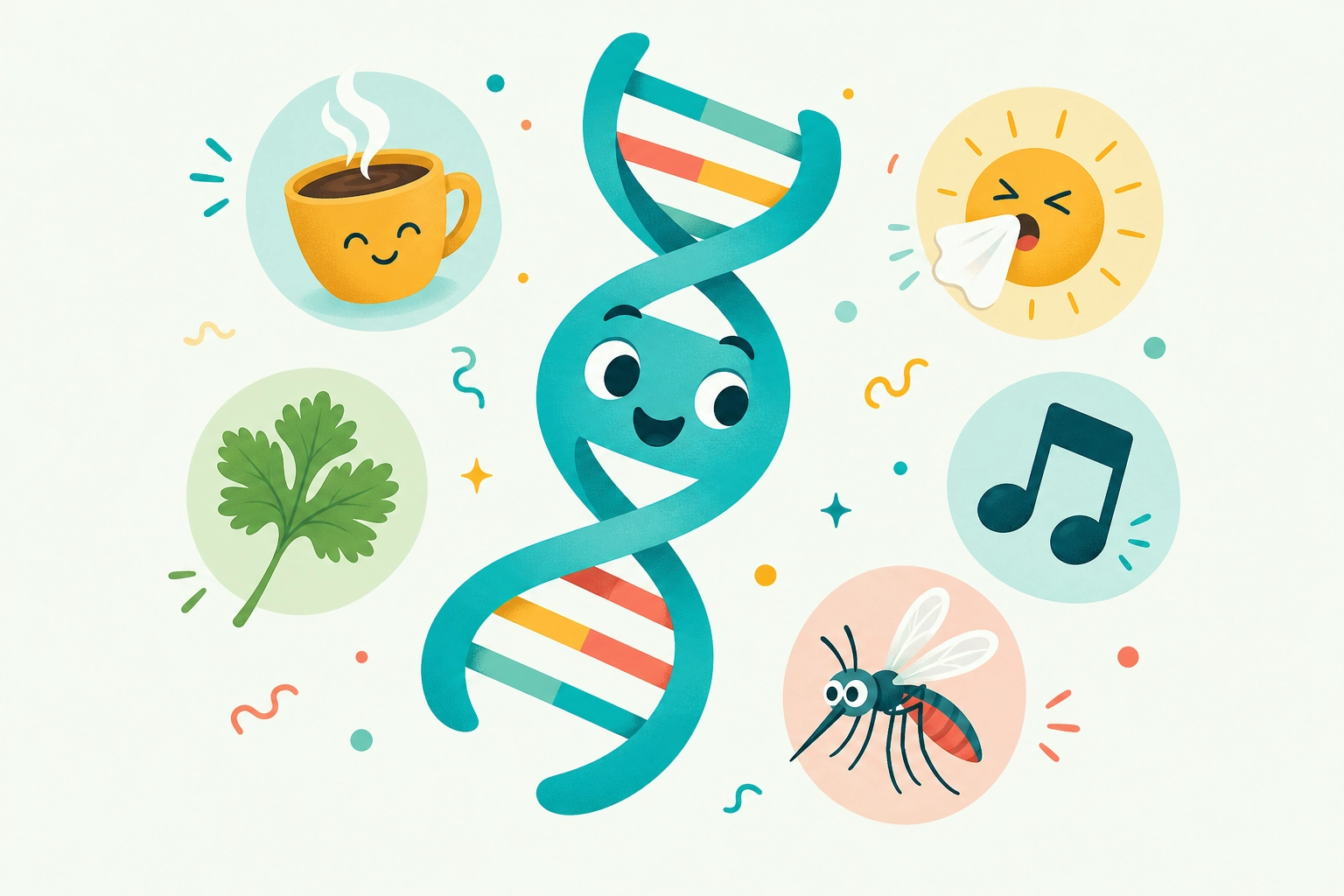
Genes don't just set eye color or height — they hide weird traits you never knew were genetic, from cilantro tasting like soap to sneezing at sunlight to being a mosquito magnet. See what your DNA is hiding.
When we say "genetics," we picture hair color, height, or looking like our parents. But our genes hide a surprising amount of quirky stuff. Here are traits that really are "because of your genes"!
If coriander tastes like soap to you, your tongue isn't broken! A GWAS found a SNP near a cluster of smell-receptor genes on chromosome 11 — notably OR6A2 — that makes some people extra-sensitive to the aldehydes in cilantro, so they perceive a soapy smell.
Step into the sun and sneeze instantly? That's the Photic Sneeze Reflex (ACHOO Syndrome), inherited as an autosomal dominant trait and found in roughly 18–35% of people, with GWAS studies identifying associated genetic loci.
Mosquitoes really do play favorites! The body odor they love is partly genetic. More in why mosquitoes bite some people more.
Believe it or not, pet preference has a genetic component too. Twin studies suggest part of being a "cat person" or "dog person" lives in your genes — see are you genetically a cat or dog person.
Some people notice an odd smell after eating asparagus; others smell nothing at all — both "making" the odor and "detecting" it are genetic.
Beyond the fun, these tiny quirks prove that a single SNP can change how we perceive the world — that's the power of reading your genetic code. Curious what else your genes hide? Start by exploring the future of DNA-based wellness.
Everyone carries something special in their genetic code that no one else has. Your DNA is the most fun story you haven't read yet — so, which of these quirks describes you?
1. Can these quirky traits really be detected in DNA?
Yes — many of these come from a single differing SNP, so they show up in genetic testing.
2. Are these traits dangerous?
Most are harmless, just individual differences, though a few can connect to health.
3. Can a DNA test reveal these traits?
Yes — modern DNA testing covers both the fun traits and serious health insights.

