
 United States (USD)
 Singapore (SGD)
 Thailand (THB)
 African Country (USD)
 Australia (AUD)
 Canada (USD)
 Egypt (USD)
 European Country (EUR)
 Hong Kong (HKD)
 Indonesia (IDR)
 Iran (USD)
 Iraq (USD)
 Japan (JPY)
 Myanmar (USD)
 Oman (USD)
 Qatar (USD)
 Saudi Arabia (USD)
 Switzerland (CHF)
 Taiwan (USD)
 Turkey (USD)
 UAE (USD)
 United Kingdom (GBP)
 International (USD)
Rated 4.98-stars across 3.9K+ reviews


 By
By
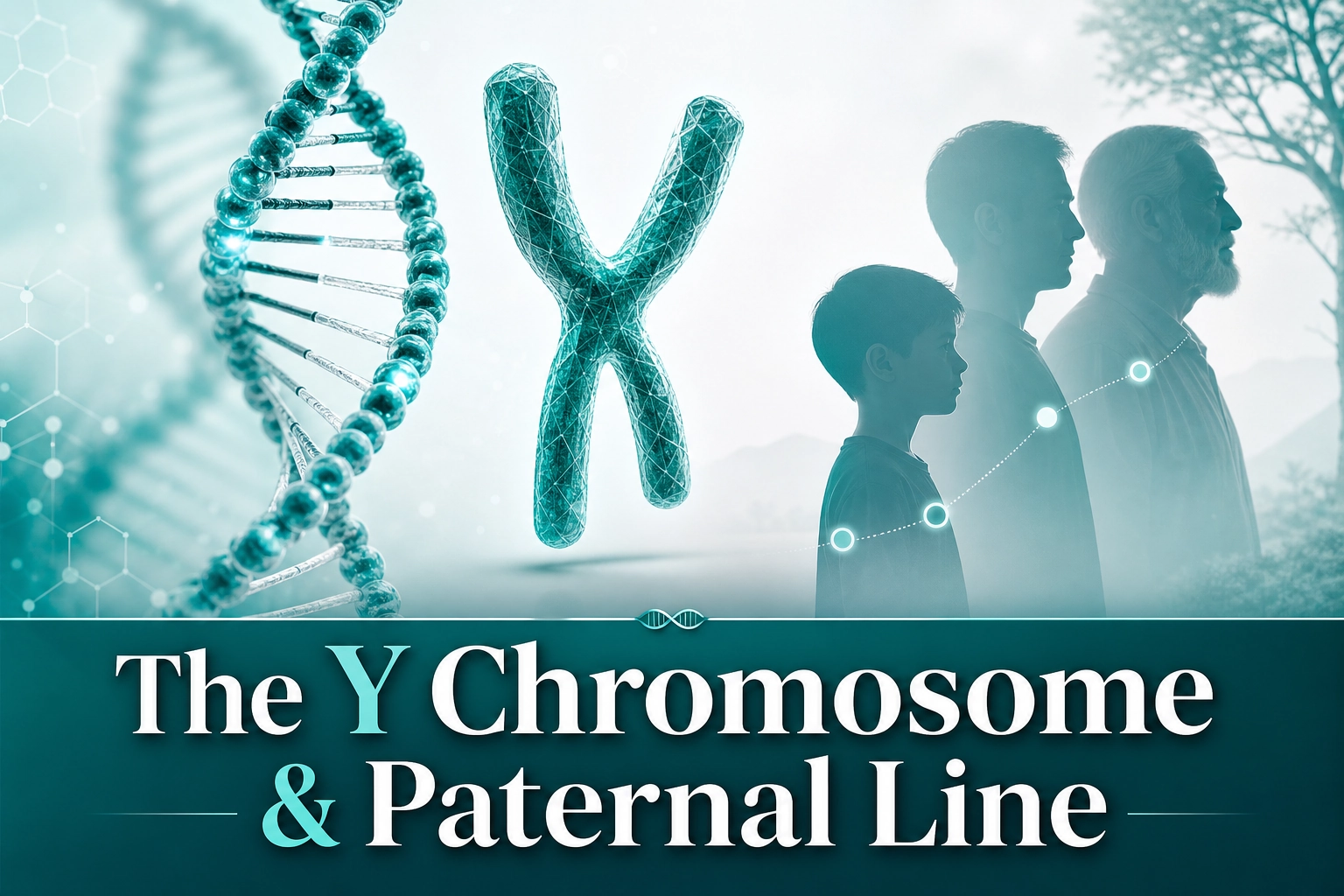
The Y chromosome exists only in men and passes from father to son almost unchanged. Learn how it traces the paternal lineage, connects with surnames, and leads to the Y-chromosomal Adam concept.
In the previous article we discussed mitochondrial DNA, which traces the maternal line. Now let's look at the other side: the Y chromosome, which tells the paternal story. The two are like parallel paths leading us back to our roots.
Humans have a pair of sex chromosomes — women are XX, men are XY. The Y chromosome therefore exists only in men and passes directly from father to son. Most of the Y chromosome doesn't undergo gene recombination with its partner, so it passes through generations almost unchanged, like a genetic surname.
Because it passes straight from father to son and changes slowly, comparing the Y chromosome across men reveals paternal relationships. Geneticists classify it into Y-haplogroups that indicate the regional origin of the paternal line. In many cultures where surnames pass through the father, Y-DNA often aligns with surnames. This connects with ancestry DNA analysis.
Like Mitochondrial Eve on the maternal side, tracing the Y chromosome of men worldwide converges on a common man in Africa, called "Y-chromosomal Adam." It doesn't mean he was the only man of his time, but the one whose Y line descends to all men today.
The limitation of Y-DNA is that it only tells the paternal line, and women don't have their own Y chromosome. Using Y-DNA together with mtDNA gives a picture of ancestry on both the father's and mother's sides. Autosomal testing (body chromosomes) provides an overview of all ancestral lines over the past few hundred years. They all complement each other.
The Y chromosome is like a "biological surname" every man carries. Studying it helps piece together family history and human migration. If you want to explore both lines of your roots, start with a DNA test.
1. Can women trace their paternal line with the Y chromosome?
Not directly, since women have no Y chromosome — but they can trace it through a direct male relative, such as a father or brother.
2. Does Y-DNA always match the surname?
It often aligns in cultures that pass surnames down the paternal line, but not always — factors like adoption or newly adopted names can break the link.
3. Did Y-chromosomal Adam and Mitochondrial Eve live at the same time?
Not necessarily — they're the common ancestors of the paternal and maternal lines respectively, and are thought to have lived in different eras.

