
 United States (USD)
 Singapore (SGD)
 Thailand (THB)
 African Country (USD)
 Australia (AUD)
 Canada (USD)
 Egypt (USD)
 European Country (EUR)
 Hong Kong (HKD)
 India (USD)
 Indonesia (IDR)
 Iran (USD)
 Iraq (USD)
 Japan (JPY)
 Myanmar (USD)
 Oman (USD)
 Qatar (USD)
 Saudi Arabia (USD)
 Switzerland (CHF)
 Taiwan (USD)
 Turkey (USD)
 UAE (USD)
 United Kingdom (GBP)
Rated 4.98-stars across 4.8K+ reviews


 By
By
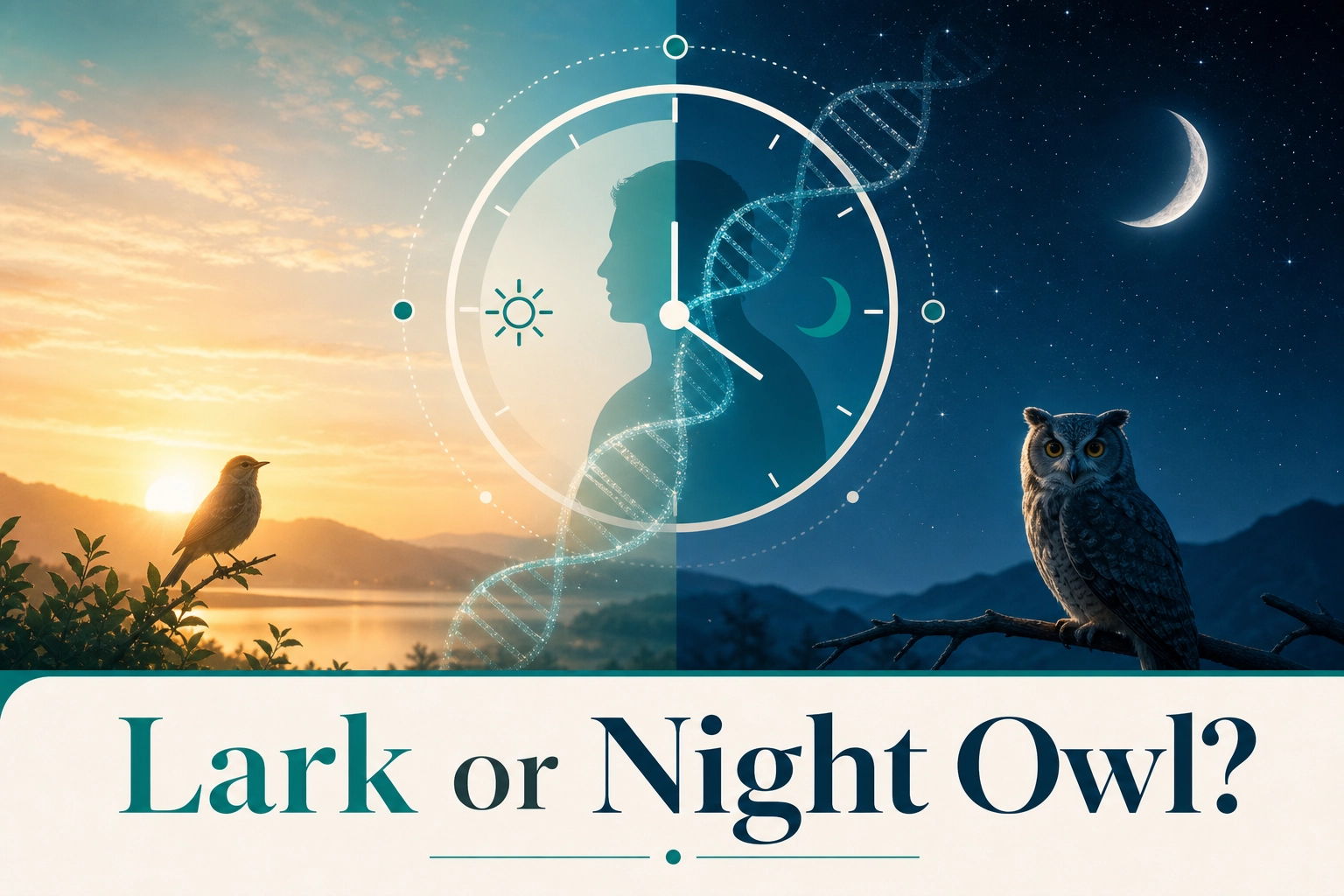
Chronotype is your tendency to be a morning lark or night owl, governed by circadian clock genes like PER3. GWAS found 350+ associated loci. Learn how it affects health and how much you can adapt it.
Why does one person wake up bright at 5 a.m. while another only hits their stride at midnight? The answer isn't just "discipline" — it's partly in our circadian clock genes. Here's what chronotype is and how much we can adapt it.
Chronotype is the expression of your internal body clock, setting when you feel most alert and most sleepy. Roughly, people are morning (morningness), intermediate, or evening (eveningness) types. This connects directly to sleep genetics.
The body clock runs on a set of genes working in a feedback loop — PER1, PER2, PER3, CRY1, CLOCK, and BMAL1. GWAS combining hundreds of thousands of people found over 350 loci associated with morningness, and interestingly, morningness is associated with slightly lower rates of depression.
A "night owl" forced to wake early for work can develop social jetlag (body clock out of sync with the social schedule), which is linked to poorer sleep quality and metabolic risk. Understanding your chronotype helps you align your schedule and eating with your body.
Although genes clearly play a role, it's important to know that many findings haven't been fully replicated (e.g., some CLOCK and PER3 associations), and chronotype also shifts with age, sex, and environment — especially natural light exposure. So we can partly adjust our body clock through behavior.
Knowing your chronotype isn't an excuse to stay up late — it's a tool to design your day to work with your body, not against it. Start understanding your body clock and genetics with a DNA test.
1. Can you change your chronotype?
Partly. Chronotype has a genetic basis in clock genes, but it can be partly shifted with natural light and gradual changes to sleep timing.
2. Can a DNA test show my chronotype?
Yes. A gene test can indicate chronotype tendency, but use it with questionnaires like the MEQ or MCTQ for accuracy.
3. What is social jetlag?
It matters. Social jetlag is when your body clock is out of sync with your social schedule, linked to poorer sleep and metabolic risk.

