
 United States (USD)
 Singapore (SGD)
 Thailand (THB)
 African Country (USD)
 Australia (AUD)
 Canada (USD)
 Egypt (USD)
 European Country (EUR)
 Hong Kong (HKD)
 India (USD)
 Indonesia (IDR)
 Iran (USD)
 Iraq (USD)
 Japan (JPY)
 Myanmar (USD)
 Oman (USD)
 Philippines (USD)
 Qatar (USD)
 Saudi Arabia (USD)
 Switzerland (CHF)
 Taiwan (USD)
 Turkey (USD)
 UAE (USD)
 United Kingdom (GBP)
Rated 4.98-stars across 4.8K+ reviews


 By
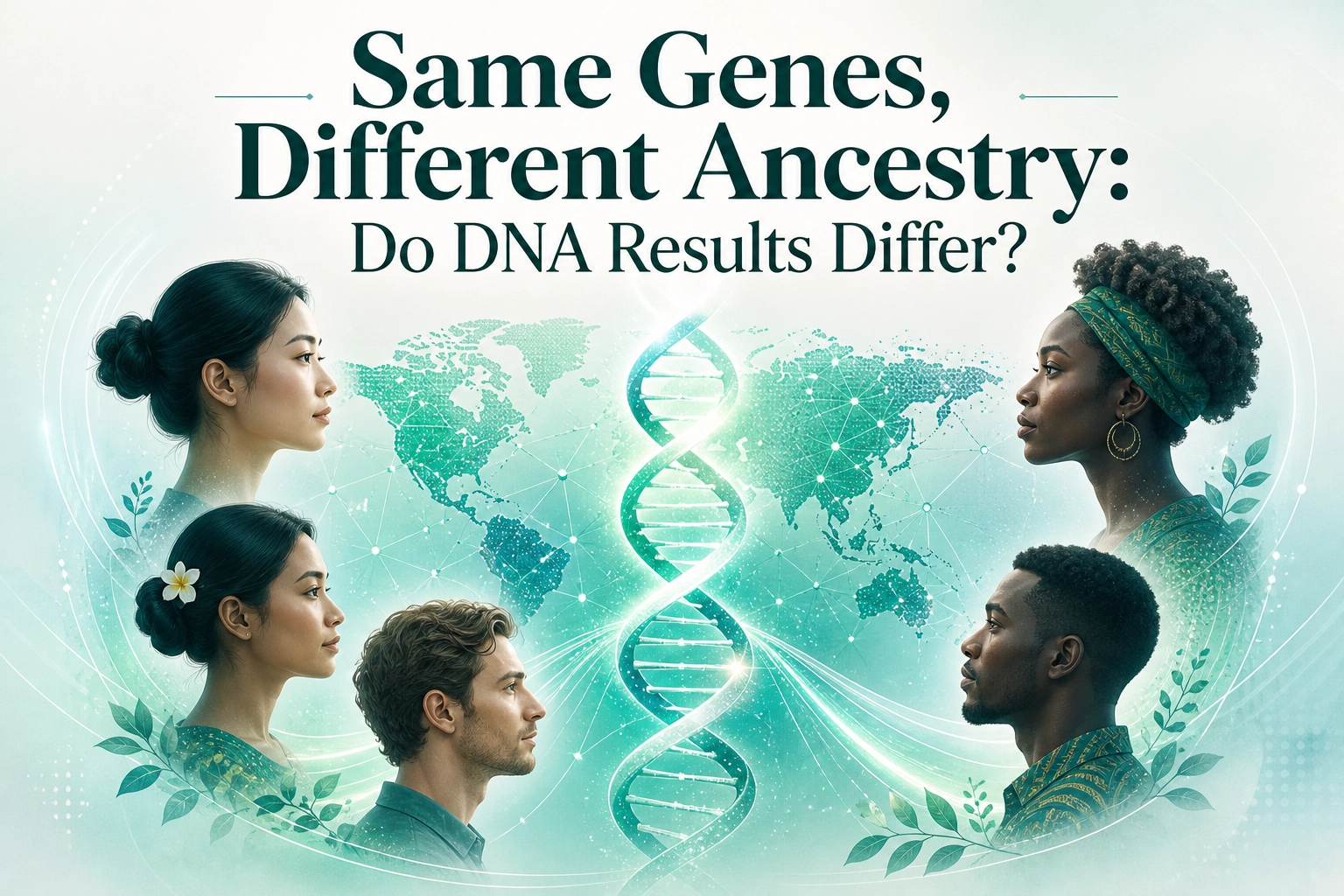
Do DNA results differ by ancestry? Most genes like ALDH2, LCT, CYP1A2 and COMT point the same direction worldwide, but allele frequencies and imputation accuracy differ — so Geneus DNA uses a customized Illumina GSA v4 chip and a multi-ethnic reference database for results that are accurate for Thais.
A question we hear often: "If a Thai person and a Westerner test the same DNA, will the results be the same or different?" The answer has two sides. On one hand, the biology of most genes is universal — the same genotype usually points the same way worldwide. On the other hand, ancestry matters more than many expect for the accuracy of how results are read. This article explains why, and how Geneus DNA handles it.
A MicroArray test reads SNPs at millions of predefined positions, then uses a process called imputation (statistical gap-filling) to estimate the positions it did not read directly, relying on a "reference panel" — a genetic database of many people.
Here is the crux: allele frequencies and the co-inheritance patterns of SNPs (linkage disequilibrium) differ across ancestries. If you use a European-only reference panel to impute data for a Thai person, accuracy drops, because the genetic patterns do not match. This is why having an ancestry-matched reference database matters so much for result quality. Read more about the testing technologies in how MicroArray, WES and WGS differ.
It starts at the testing step: Geneus DNA uses an Illumina GSA v4 chip that we customized under our own patent, so it covers genetic positions that matter more for Thai and Asian people. The data then goes through imputation against a multi-ethnic reference database — Thai, Asian, Chinese, Japanese, as well as European and African — making results for people in the Asian region far more accurate. Accuracy (R²) is mostly around 0.95 on average, and imputation can fill in up to roughly 30 million positions to simulate a resolution close to whole-genome sequencing (WGS).
Just as important is the size of the database. Geneus DNA has now collected genetic data from more than 200,000 Asian and Southeast Asian individuals — larger than a national programme such as Genomics Thailand, which set a target of sequencing around 50,000 Thai genomes. The bigger the regional database, the more accurate and fair the results become for Thai people.
Even though allele frequencies differ by ethnicity, the biology of most genes is universal: if you carry a given genotype, the result usually goes the same way whatever your ancestry. Some heavily studied, globally used examples:
For this group of genes, interpretation does not depend on your ethnicity — the same genotype means the same thing. What differs is only the "frequency" at which we find that allele in each population.
There are cases where ancestry creates a meaningful difference — and this is exactly where an ancestry-matched database helps most:
If you have tested your DNA with an overseas service like 23andMe or AncestryDNA, you do not have to start over. You can upload your raw DNA data and let Geneus DNA analyse it further with a multi-ethnic reference database and ancestry-matched imputation, giving you fresh insights from data you already have. (The upload-page link will be added shortly.)
1. If a Thai person and a foreigner test the same DNA gene, will the results differ?
For most genes the result points the same direction worldwide — the same genotype means the same thing whatever your ancestry. What differs is the allele frequency and imputation accuracy, which is why Geneus DNA uses a multi-ethnic reference database to make results more accurate for Thais.
2. What is imputation, and why does it need to be ancestry-specific?
Imputation statistically fills in genetic data at positions not read directly, using a reference panel from many people. Because allele frequencies and SNP co-inheritance patterns differ across ancestries, an ancestry-matched reference panel gives more accurate results.
3. I already have results from 23andMe or AncestryDNA — can I reuse them?
Yes. You can upload your raw DNA data and have Geneus DNA analyse it further with a multi-ethnic reference database and ancestry-matched imputation, giving you fresh insights from data you already have.
4. How large is Geneus DNA's Thai/Asian database?
Geneus DNA has now collected genetic data from more than 200,000 Asian and Southeast Asian individuals — larger than a national programme like Genomics Thailand, which targeted around 50,000 Thai genomes. The bigger the database, the more accurate the results for Thai people.

