
 United States (USD)
 Singapore (SGD)
 Thailand (THB)
 African Country (USD)
 Australia (AUD)
 Canada (USD)
 Egypt (USD)
 European Country (EUR)
 Hong Kong (HKD)
 India (USD)
 Indonesia (IDR)
 Iran (USD)
 Iraq (USD)
 Japan (JPY)
 Myanmar (USD)
 Oman (USD)
 Philippines (USD)
 Qatar (USD)
 Saudi Arabia (USD)
 Switzerland (CHF)
 Taiwan (USD)
 Turkey (USD)
 UAE (USD)
 United Kingdom (GBP)
Rated 4.98-stars across 4.8K+ reviews


 By
By
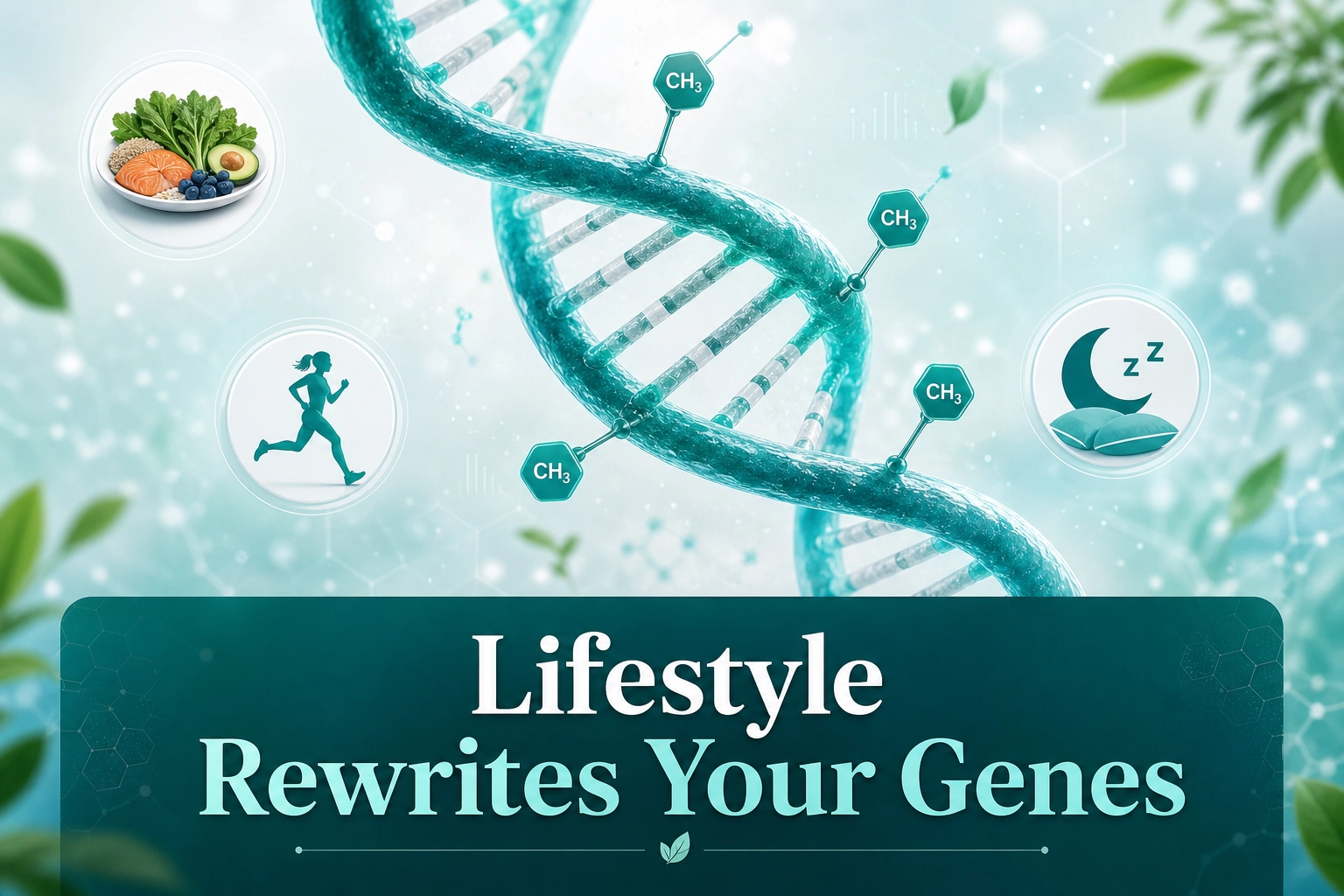
Do genes really determine everything? Epigenetics is the mechanism that controls whether genes are on or off without changing the DNA sequence — and our lifestyle truly affects it. Learn why we're not slaves to our genes.
We often hear that "genes determine everything," but the truth is more nuanced. Even though the DNA sequence is fixed, the body has a system controlling which genes get "read" and when. This system is called epigenetics, and it's directly influenced by our way of life.
Think of DNA as a book — epigenetics is the notes and bookmarks that say which pages to read often and which to skip. The letters (DNA sequence) don't change, but their "use" does. The main mechanisms are adding methyl groups (DNA methylation) and modifying histone proteins, which determine whether genes are switched on or off.
Research shows everyday factors affect our epigenome — diet, exercise, stress, sleep, and smoking. For example, regular exercise is linked to healthier methylation patterns, while chronic stress may alter the expression of inflammation-related genes. This connects with exercise genetics.
Remarkably, some epigenetic changes may be passed to the next generation to a degree. Studies in both animals and humans suggest parental nutrition or stress may leave marks in their children. While the mechanisms in humans still need more study, the idea has greatly changed how we view "heredity."
The key conclusion of epigenetics is that our behavior has power. We can't choose the DNA sequence we inherit, but we can choose how we live, which affects which genes get activated. This is good news that empowers proactive health care. It aligns with nutrigenomics.
Epigenetics is a bridge between "nature" (genes) and "nurture" (environment) that were once seen as separate. It reminds us that every daily choice has meaning at the molecular level. Knowing your own genes is a great starting point for living wisely. Start with a DNA test.
1. How is epigenetics different from genetics?
Genetics is the DNA sequence you inherit, while epigenetics is the system that controls which genes are switched on or off — without changing the DNA sequence itself.
2. Can lifestyle really change your genes?
It can change gene expression — diet, exercise, sleep, and stress all affect epigenetic patterns — though it doesn't alter your underlying DNA sequence.
3. Can epigenetic changes be passed to your children?
There's evidence in animals and some in humans that they may be to a degree, but the mechanisms in humans still need more study, so it should be interpreted cautiously.

