
 United States (USD)
 Singapore (SGD)
 Thailand (THB)
 African Country (USD)
 Australia (AUD)
 Canada (USD)
 Egypt (USD)
 European Country (EUR)
 Hong Kong (HKD)
 India (USD)
 Indonesia (IDR)
 Iran (USD)
 Iraq (USD)
 Japan (JPY)
 Myanmar (USD)
 Oman (USD)
 Philippines (USD)
 Qatar (USD)
 Saudi Arabia (USD)
 Switzerland (CHF)
 Taiwan (USD)
 Turkey (USD)
 UAE (USD)
 United Kingdom (GBP)
Rated 4.98-stars across 4.8K+ reviews


 By
By
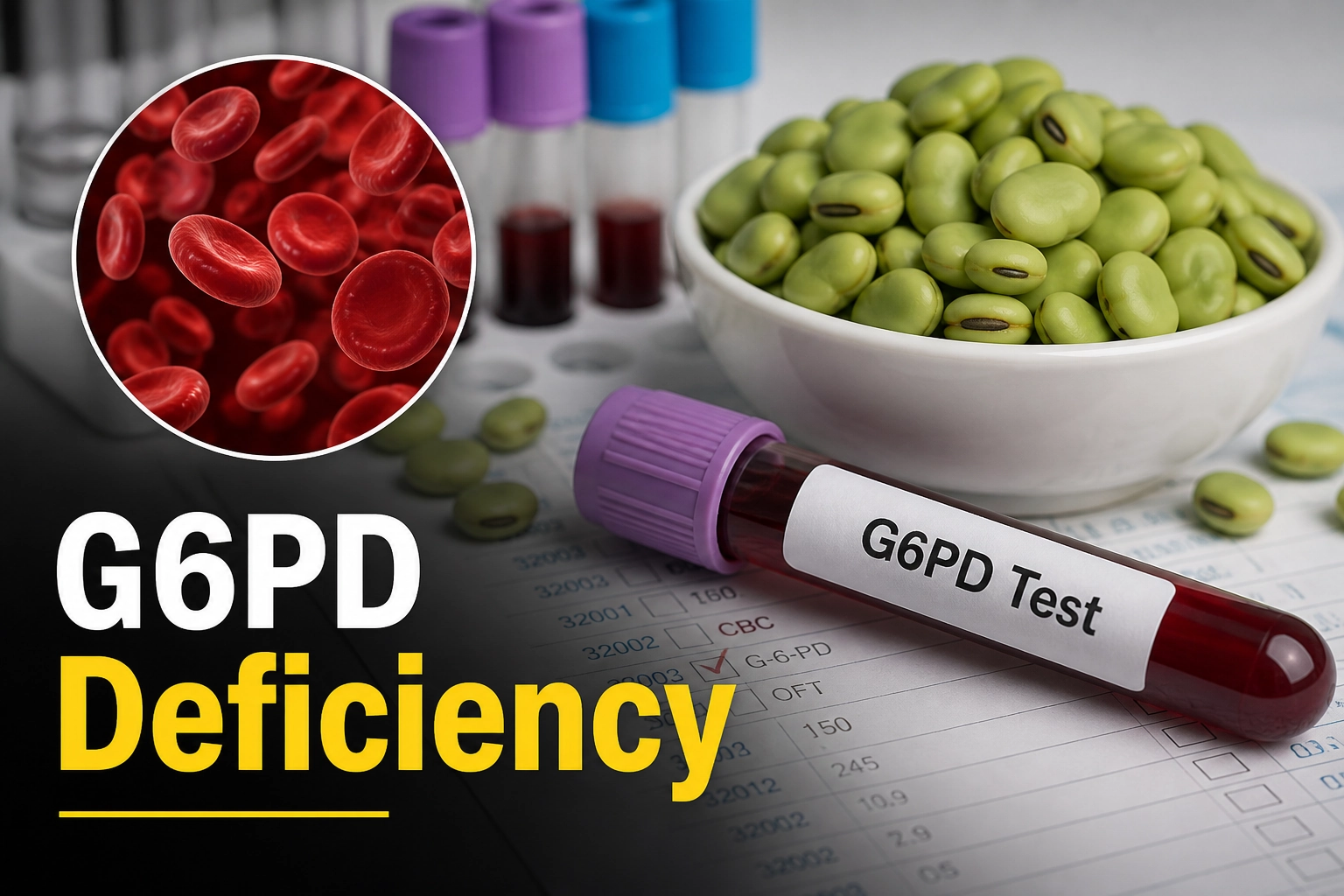
G6PD deficiency is a common X-linked genetic condition in Southeast Asia. Most people have no symptoms until a trigger like fava beans or certain drugs sets off red blood cell breakdown. Here is why it matters and what to avoid.
Hello, from the Geneus DNA medical team. I want to introduce a condition that may sound obscure but is actually very close to home for many Thai families: G6PD deficiency. Many families first hear about it when a newborn develops jaundice, or when an older relative takes a certain medicine and suddenly passes dark-colored urine for no obvious reason. A correct understanding of this condition genuinely prevents serious events, and it is a great example of how genetic information can be used to look after yourself in everyday life.
The G6PD enzyme is the first enzyme in the pentose phosphate pathway. Its job is to produce NADPH, which acts like an "anti-rust shield" for red blood cells. NADPH keeps antioxidants such as glutathione regenerated and ready to neutralize oxidative stress at all times.
Red blood cells are unusual in that they have no nucleus and no mitochondria, so they rely almost entirely on this pathway to protect themselves from oxidants. When G6PD activity is lower than normal, red blood cells become especially fragile when they encounter something with oxidizing properties, leading to hemolysis (red blood cell breakdown). Possible signs include fatigue, pallor or jaundice, dark cola-colored urine, and in severe cases a rapid drop in blood counts requiring hospital care.
The G6PD gene sits on the X chromosome, which is why the condition is X-linked. Men have only one X chromosome, so if they inherit a deficient copy they usually show clear symptoms. Women have two X chromosomes; a woman with a single deficient copy is a "carrier," but because of random X-inactivation, some women can still have low enzyme levels and develop symptoms. So this should not be thought of as a men-only condition.
Interestingly, the condition is common in regions that historically had heavy malaria transmission — Africa, the Mediterranean, the Middle East, and Southeast Asia. Scientists believe G6PD deficiency may offer some advantage against malaria, so it has been favored and preserved in these populations through evolution. This is one reason it is fairly common among Thai people and is part of newborn screening in many areas.
The core of managing G6PD deficiency is avoiding oxidative triggers, which fall into three main groups.
Several drug classes can trigger red blood cell breakdown in people with G6PD deficiency. Commonly cited examples include:
The key point is: do not self-medicate, and always tell your doctor and pharmacist that you have G6PD deficiency before starting any new medicine — some of these are common, over-the-counter drugs. This connects to pharmacogenomics, the study of how each person's genetics affect their response to drugs, and it is distinct from genetics-related drug allergy, which works through a different mechanism.
I want to be clear that having G6PD deficiency does not mean you will always have severe symptoms. Severity depends on the specific variant (there are many variants with different residual enzyme levels), the amount and type of trigger, and individual factors. Many people live entirely normal lives as long as they avoid triggers well.
On the other hand, lists of drugs and foods to avoid do not fully agree across sources, and the strength of evidence for some drugs varies — some are safe at normal doses but risky at high doses. So you should not make decisions on your own from an internet list. Genetic testing or enzyme measurement is just one piece of information, not a complete diagnosis or treatment order in itself. Whenever you notice unusual symptoms such as jaundice, dark urine, or sudden fatigue, see a doctor promptly, and always plan your medications together with your doctor and pharmacist.
1. Can G6PD deficiency be cured?
There is currently no cure, because it is a genetic condition present from birth. However, most people live normal lives as long as they avoid the triggers that cause red blood cell breakdown. Care therefore focuses on prevention rather than treating an episode after it happens.
2. Can women have G6PD deficiency?
Yes. Although it is more clearly symptomatic in men because of the X-linked inheritance, female carriers can also have low enzyme levels and develop symptoms due to random X-inactivation. They should be just as careful about triggers.
3. Can I take paracetamol if I have G6PD deficiency?
In general, many commonly used drugs are safe at normal doses, but the risk of each drug differs and some data remain unclear. The safest approach is to tell your doctor and pharmacist that you have the condition before starting any new medicine, and never self-medicate without advice.
4. How do I find out if I have G6PD deficiency?
It can be detected by measuring G6PD enzyme activity in the blood, or by genetic testing to look for gene variants. Many areas already screen newborns. If you are concerned or have a family history, consult a doctor to consider the appropriate test.

