
 United States (USD)
 Singapore (SGD)
 Thailand (THB)
 African Country (USD)
 Australia (AUD)
 Canada (USD)
 Egypt (USD)
 European Country (EUR)
 Hong Kong (HKD)
 India (USD)
 Indonesia (IDR)
 Iran (USD)
 Iraq (USD)
 Japan (JPY)
 Myanmar (USD)
 Oman (USD)
 Philippines (USD)
 Qatar (USD)
 Saudi Arabia (USD)
 Switzerland (CHF)
 Taiwan (USD)
 Turkey (USD)
 UAE (USD)
 United Kingdom (GBP)
Rated 4.98-stars across 4.8K+ reviews


 By
By
Understand what genetic counseling is, when to seek it, and what actually happens in the counseling room, presented in a supportive, non-directive way that supports your own decisions.
Hello, as a physician who works with genetic data, I want to walk you through something that is often overlooked: genetic counseling. Many people think a DNA test ends at "what did the result say." In reality, the true value lies in interpreting the result and planning what comes next, and that is the work of counseling. In this article I will explain what it is, when to seek it, and what happens in the counseling room, guided by the most important principle of all: providing balanced information to support your decision, not telling you what to do.
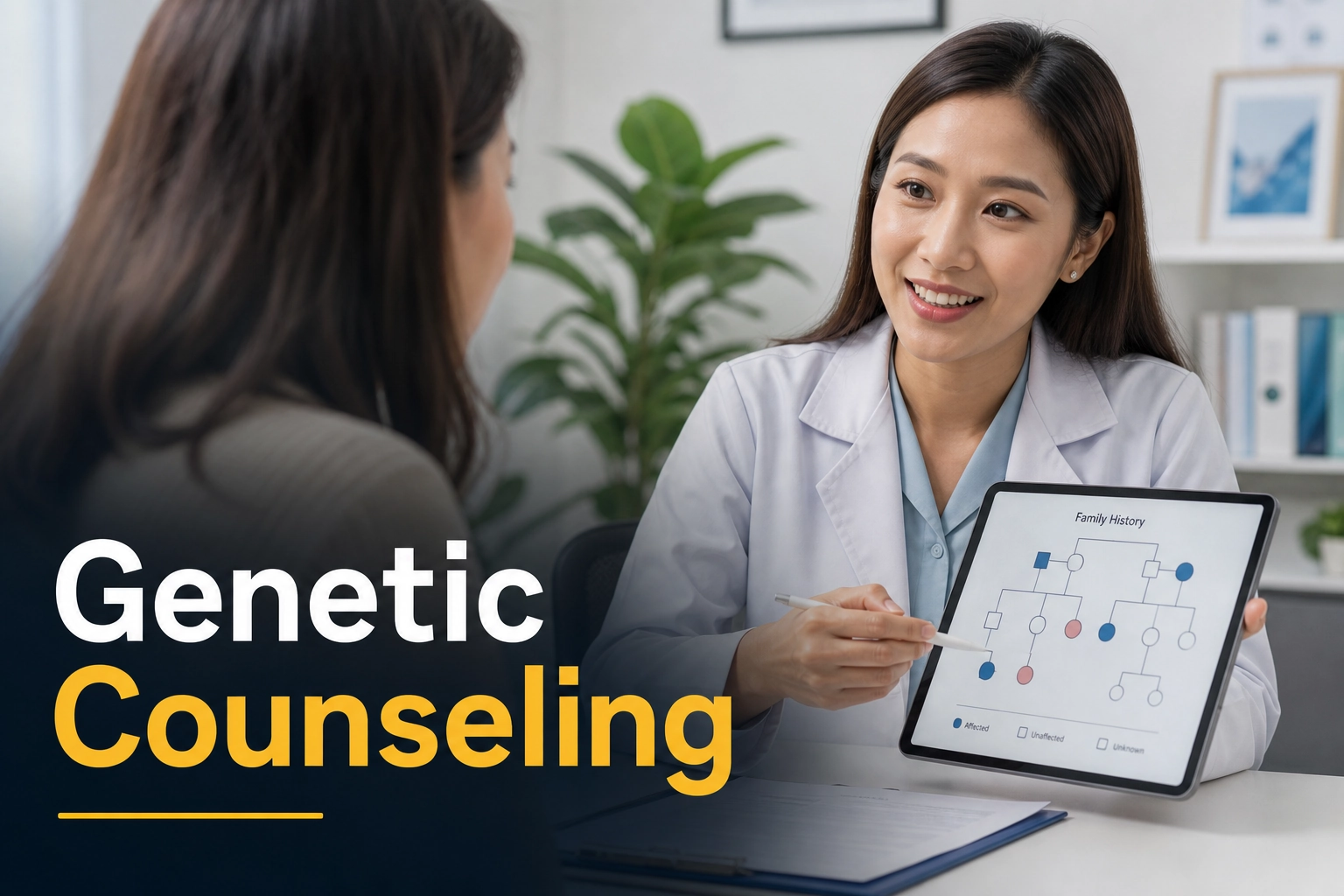
Genetic counseling is a communication process that helps individuals and families understand the medical, psychological, and familial aspects of conditions with a genetic component. A counselor (a genetic counselor or a physician trained in this area) helps you:
The point I want to emphasize is the word non-directive, a key ethical foundation of this work. A counselor's role is not to say "you should test" or "you should decide this way," but to place all the information and options in front of you and respect the decision that fits your values and life context.
Not everyone needs to see a genetic counselor, but there are situations where a conversation before or after testing is especially helpful.
If a family member has been diagnosed with an inherited condition, such as thalassemia, certain muscular disorders, or a condition diagnosed at a young age, counseling helps assess how likely you or your children might be affected.
Couples planning to have children can undergo carrier screening to see whether both partners carry the same recessive condition. In Thailand, a common example is thalassemia. If both are carriers, the counselor will explain the odds and the available options without deciding for you.
During pregnancy, screening may be offered, such as NIPT (non-invasive prenatal screening for chromosomal conditions from the mother's blood) or additional diagnostic testing. Counseling helps you understand that a positive screening result means "higher risk," not a definitive diagnosis, and clarifies what steps can follow.
If your family has breast, ovarian, or colorectal cancer, multiple relatives with the same cancer, or cancer at a young age, it may involve genes such as BRCA1/BRCA2 or Lynch syndrome. Counseling helps assess whether genetic testing is right for you and how a result would guide a surveillance plan. Read more in our article on hereditary cancer risk.
Many people worry about how to prepare. In truth, the atmosphere is a more relaxed conversation than you might expect. It generally involves:
In some cases, genetic information is used in other ways too, such as matching tissue compatibility for organ transplantation, which relies on HLA typing, another example of how understanding genetics supports medical decisions.
For an honest picture, I want to reiterate the key limitations:
1. How is genetic counseling different from a regular DNA test?
A DNA test analyzes a sample to read genetic information. Genetic counseling is the process before and after testing that helps you understand what the result means in the context of your health and family, and helps plan the next steps. Counseling is what makes the test data meaningful and actionable.
2. If my result shows a risk gene, does that mean I will definitely get the disease?
Not necessarily. Results describe probability, not a verdict. A risk gene means a higher chance, but most conditions arise from genetics together with environment and lifestyle. A counselor can help explain how large that risk is and what surveillance or risk-reduction options exist.
3. Will genetic counseling tell me what decision to make?
No. The core principle of this work is non-directive support. The counselor lays out all the information and options for you but does not decide on your behalf. The decision rests on your own values, readiness, and life context.
4. What should I prepare before seeing a counselor?
The most useful thing is your family health history as far as you can gather it, such as who in the family had which condition, the age at diagnosis, and your ancestry or ethnic background, plus any previous test results and the questions you want answered. The more detailed the information, the more accurate the assessment.

