
 United States (USD)
 Singapore (SGD)
 Thailand (THB)
 African Country (USD)
 Australia (AUD)
 Canada (USD)
 Egypt (USD)
 European Country (EUR)
 Hong Kong (HKD)
 India (USD)
 Indonesia (IDR)
 Iran (USD)
 Iraq (USD)
 Japan (JPY)
 Myanmar (USD)
 Oman (USD)
 Philippines (USD)
 Qatar (USD)
 Saudi Arabia (USD)
 Switzerland (CHF)
 Taiwan (USD)
 Turkey (USD)
 UAE (USD)
 United Kingdom (GBP)
Rated 4.98-stars across 4.8K+ reviews


 By
By
Spermidine is a compound in foods like wheat germ, aged cheese, and natto that may induce autophagy, the cell's self-cleaning process. Here is an honest look at what the science does and does not yet show.
Hi, I'm Alis. Working in the longevity space, I get asked about "spermidine" more and more often. Many people spot the name on an anti-aging supplement label and wonder what it actually is and why it has anything to do with cellular repair. Today I want to walk you through spermidine honestly, both the genuinely exciting parts and the parts where the science still says "we don't know yet."
Spermidine is a naturally occurring polyamine found in the cells of nearly every living organism, including our own. Your body obtains it three ways: it synthesizes spermidine inside cells, gets some from gut bacteria, and absorbs it from the food you eat.
Autophagy (literally "self-eating") is the process by which a cell clears out damaged parts, misfolded proteins, and worn-out organelles, then breaks them down and recycles them into fresh building blocks. Think of it as the cell's "housekeeping system." The 2016 Nobel Prize in Physiology or Medicine (Yoshinori Ohsumi) deepened our understanding of this mechanism, and well-functioning autophagy is thought to be linked to better long-term cellular health.
What makes spermidine interesting is that, in cell and animal experiments, it can induce autophagy by inhibiting certain enzymes and shifting the activity of genes tied to cellular recycling. That has led scientists to explore whether it acts as one of the body's natural "switches" for this process.
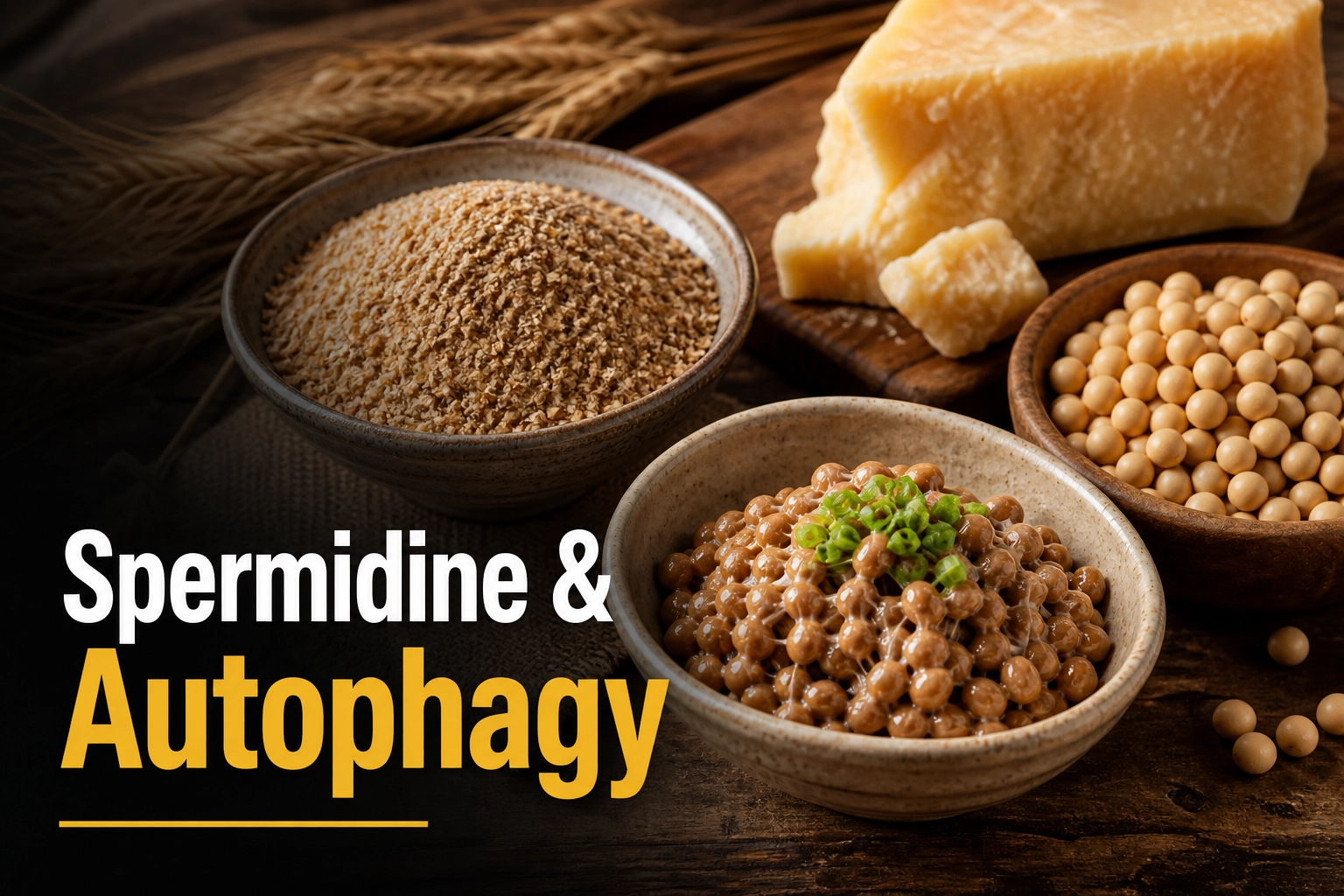
The good news is that spermidine isn't only found in capsules. It's present in everyday foods, especially fermented items and certain plant foods.
To me, this is the real charm of spermidine: it aligns with a Mediterranean-style diet and traditional fermented foods, eating patterns that already have solid health evidence behind them. For most people, adding these foods is a "more upside than downside" move.
Here I really want everyone to separate the levels of evidence, because it matters a lot.
In yeast, flies, worms, and mice, giving spermidine clearly extends lifespan and induces autophagy. Mice given spermidine also showed benefits for the heart and brain function in some experiments. This body of evidence is robust and has been reproduced across multiple labs.
Most human research is still observational epidemiology. For example, population studies have found that people with higher spermidine intake tend to have lower mortality and better heart health. But I have to stress that association is not causation. People who eat a lot of these foods often have healthier lifestyles overall, so it's hard to isolate spermidine as the direct cause.
There have been small RCTs in older adults looking at spermidine supplements and memory, with intriguing early signals, but the sample sizes were small and the durations short, not enough to support broad recommendations. Larger human trials are currently underway.
As someone in the longevity field, I think being honest about the limits matters just as much as talking up the benefits.
The advice I'm comfortable giving: prioritize real foods naturally rich in spermidine first. If you're curious about supplements, talk to a doctor, especially if you have a medical condition or are pregnant, and look at genetics and lifestyle as a whole picture. A DNA test like Geneus DNA's is just one "navigational input," not a verdict on your health. If you'd like to read more about autophagy and fasting, I recommend our article on autophagy, fasting, and genetics, and our piece on NAD+ and longevity.
1. Does spermidine really slow aging?
In animal studies spermidine clearly extends lifespan and induces autophagy, but in humans the evidence is still mostly observational, and RCTs are ongoing. So we cannot yet conclude that it 'slows aging' in people. It's best seen as a promising, interesting food component, not a miracle drug.
2. Should I take a spermidine supplement or get it from food?
For most people, getting spermidine from real foods like wheat germ, aged cheese, natto, and mushrooms is a safe approach that also delivers other nutrients. If you're interested in a supplement, consult a doctor first, since there's no clear consensus on the optimal dose.
3. Which foods are high in spermidine?
Rich sources include wheat germ, long-aged cheeses like cheddar and parmesan, fermented soybeans such as natto, mushrooms, nuts, and whole grains. Fermented foods tend to be especially high.
4. What is autophagy?
Autophagy is the process by which cells clear out and break down damaged parts, misfolded proteins, and worn-out organelles to recycle them into fresh building blocks. Think of it as the cell's cleanup and maintenance system, which is linked to long-term cellular health.

