
 United States (USD)
 Singapore (SGD)
 Thailand (THB)
 African Country (USD)
 Australia (AUD)
 Canada (USD)
 Egypt (USD)
 European Country (EUR)
 Hong Kong (HKD)
 India (USD)
 Indonesia (IDR)
 Iran (USD)
 Iraq (USD)
 Japan (JPY)
 Myanmar (USD)
 Oman (USD)
 Philippines (USD)
 Qatar (USD)
 Saudi Arabia (USD)
 Switzerland (CHF)
 Taiwan (USD)
 Turkey (USD)
 UAE (USD)
 United Kingdom (GBP)
Rated 4.98-stars across 4.8K+ reviews


 By
By
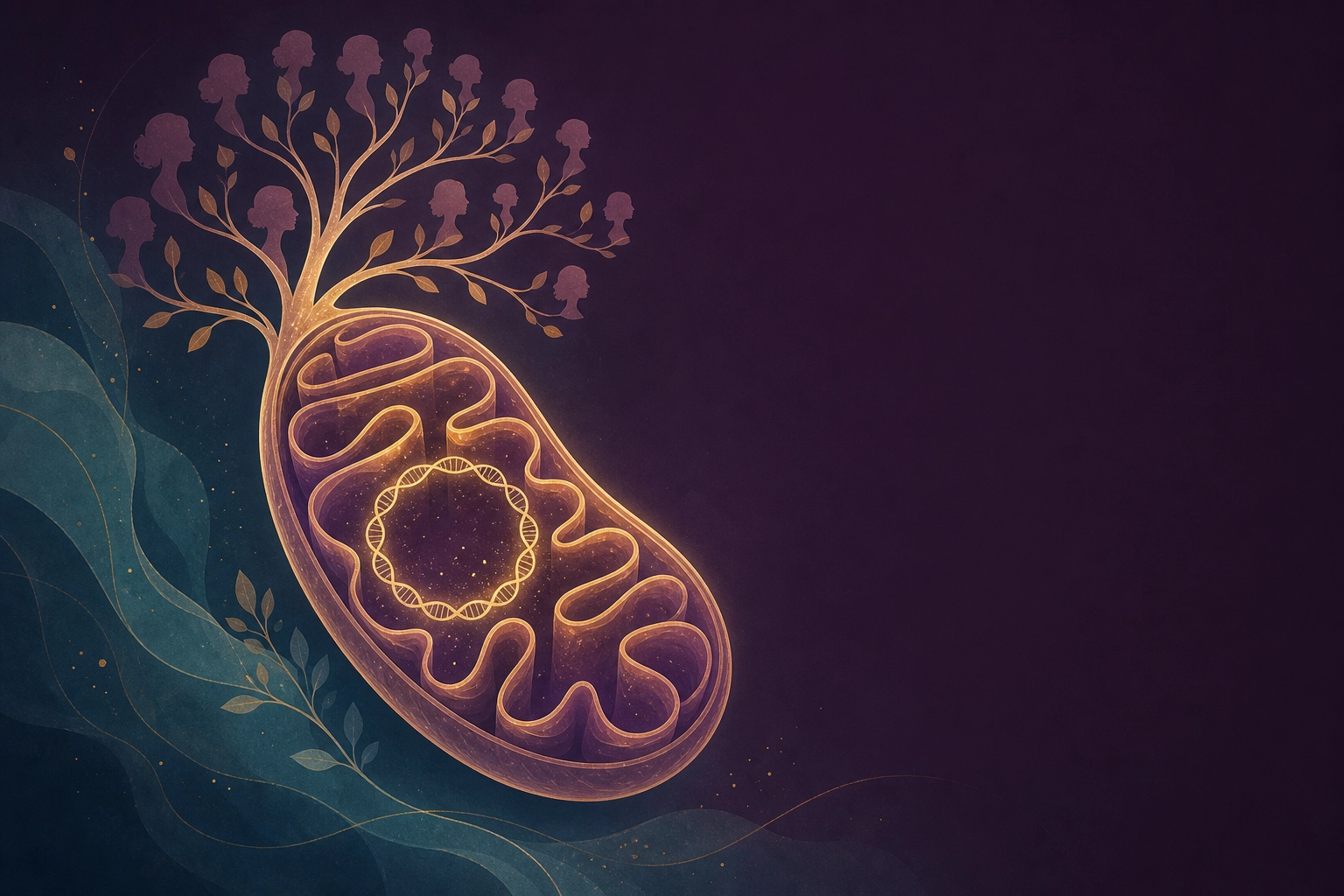
Mitochondrial DNA passes only from mother to all her children, never through the father, making it a powerful tool to trace your maternal line back to Mitochondrial Eve — and it's also tied to cellular energy and health.
When we think of DNA, we picture the 23 chromosome pairs in the nucleus. But there's another set outside it — inside the mitochondria, the organelles that act as the cell's "power plants." This mtDNA has special genetic properties.
At fertilization, nearly all mitochondria come from the mother's egg; the father's (from sperm) are eliminated. As a result, mtDNA passes from mother to all her children almost unchanged. That makes it a powerful tool for tracing the maternal line — directly tied to ancestry DNA analysis. (A few very rare cases of biparental transmission have been reported, but maternal inheritance holds true for virtually everyone.)
Because mtDNA changes slowly and predictably, scientists trace it back to "Mitochondrial Eve" — the most recent common maternal ancestor of all living humans, who lived in Africa around 150,000–200,000 years ago (note she is the most recent matrilineal ancestor, not the first or only woman of her time). Maternal haplogroup assignment also maps the migration routes of the women in your lineage, connected to Southeast Asian population genetics.
Mitochondria are the cell's main energy source, so mutations in mtDNA are linked to mitochondrial diseases affecting energy-hungry organs like the brain and muscles. Researchers have also studied links between maternal haplogroups and aging or chronic disease (though findings remain mixed). Understanding mtDNA has value for both ancestry and medicine.
Everyone carries their "mother's record" in every cell. mtDNA is the thread connecting us back through hundreds of generations of women. Reading it is reading one chapter of human history written inside you. Begin exploring your roots with the future of DNA-based wellness.
1. Do men have mtDNA?
Yes — all children inherit mtDNA from their mother, but only daughters pass it on to the next generation.
2. How is mtDNA different from Y-DNA?
mtDNA traces the maternal line; Y-DNA traces the paternal line. Testing both gives a more complete ancestry picture.
3. Does a general DNA test include mtDNA?
Yes — modern ancestry testing often includes mtDNA analysis to identify your maternal haplogroup.

