
 United States (USD)
 Singapore (SGD)
 Thailand (THB)
 African Country (USD)
 Australia (AUD)
 Canada (USD)
 Egypt (USD)
 European Country (EUR)
 Hong Kong (HKD)
 India (USD)
 Indonesia (IDR)
 Iran (USD)
 Iraq (USD)
 Japan (JPY)
 Myanmar (USD)
 Oman (USD)
 Philippines (USD)
 Qatar (USD)
 Saudi Arabia (USD)
 Switzerland (CHF)
 Taiwan (USD)
 Turkey (USD)
 UAE (USD)
 United Kingdom (GBP)
Rated 4.98-stars across 4.8K+ reviews


 By
By
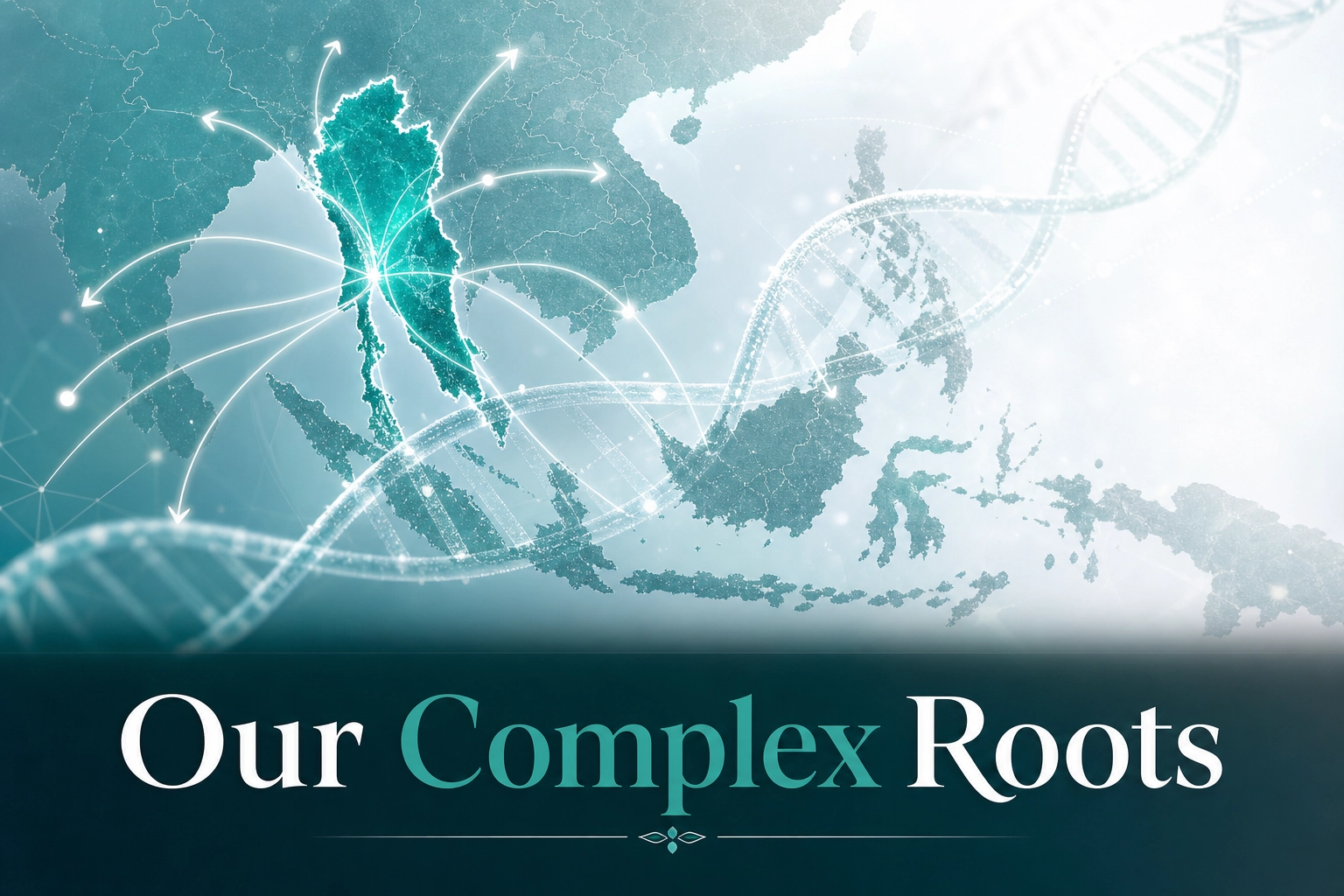
Southeast Asian and Thai populations are highly genetically diverse from multiple migration waves. Explore where our roots come from — and the limits of ancestry testing.
Southeast Asia has one of the most complex migration histories on Earth. As a physician interested in population genetics, I want to explore why the "roots" of people here — Thais included — are more fascinating than you might think.
The region has been a migration crossroads since prehistory: indigenous hunter-gatherers, early farmers from southern China, and maritime trade with India. The result is layered admixture stacked over millennia.
A study using hundreds of thousands of SNPs from nearly a thousand Thai individuals found that Thais can be resolved into genetically distinct subgroups by region and language family — not one homogeneous population. Some carry a high proportion of southern-Chinese ancestry; others show a clear South Asian component.
Recent work finds South Asian (Indian)-related ancestry across several Thai groups, consistent with ancient maritime trade, and mitochondrial DNA studies point to a maternal-line influence in those connections. These are the same tools used in ancestry DNA analysis.
Ancestry percentages are a statistical inference, not a fixed number, and accuracy depends on the size and diversity of the reference database — and SEA populations remain far less sampled than European ones. Results may therefore keep gaining detail as databases grow.
The more we decode this region's genetics, the clearer it becomes that being "Thai" and "Southeast Asian" is the product of many peoples meeting across thousands of years. Understanding your own roots can start with a DNA test.
1. Do all Thai people share the same genetics?
No. Research shows Thai people have several genetic subgroups that differ by region and language family.
2. Do Thai people have Indian ancestry?
There are traces. Studies find South Asian (Indian)-related ancestry across several Thai groups, linked to ancient maritime trade.
3. How accurate are ancestry results?
Somewhat — but treat it as a statistical estimate, not a fixed figure. It improves as reference databases grow.

