


 United States (USD)
 Singapore (SGD)
 African Country (USD)
 Australia (AUD)
 Canada (USD)
 Egypt (USD)
 European Country (EUR)
 Hong Kong (HKD)
 India (USD)
 Indonesia (IDR)
 Iran (USD)
 Iraq (USD)
 Japan (JPY)
 Myanmar (USD)
 Oman (USD)
 Philippines (USD)
 Qatar (USD)
 Saudi Arabia (USD)
 Switzerland (CHF)
 Taiwan (USD)
 Turkey (USD)
 UAE (USD)
 United Kingdom (GBP)
 International (USD)
Rated 4.98-stars across 4.8K+ reviews



 By
By
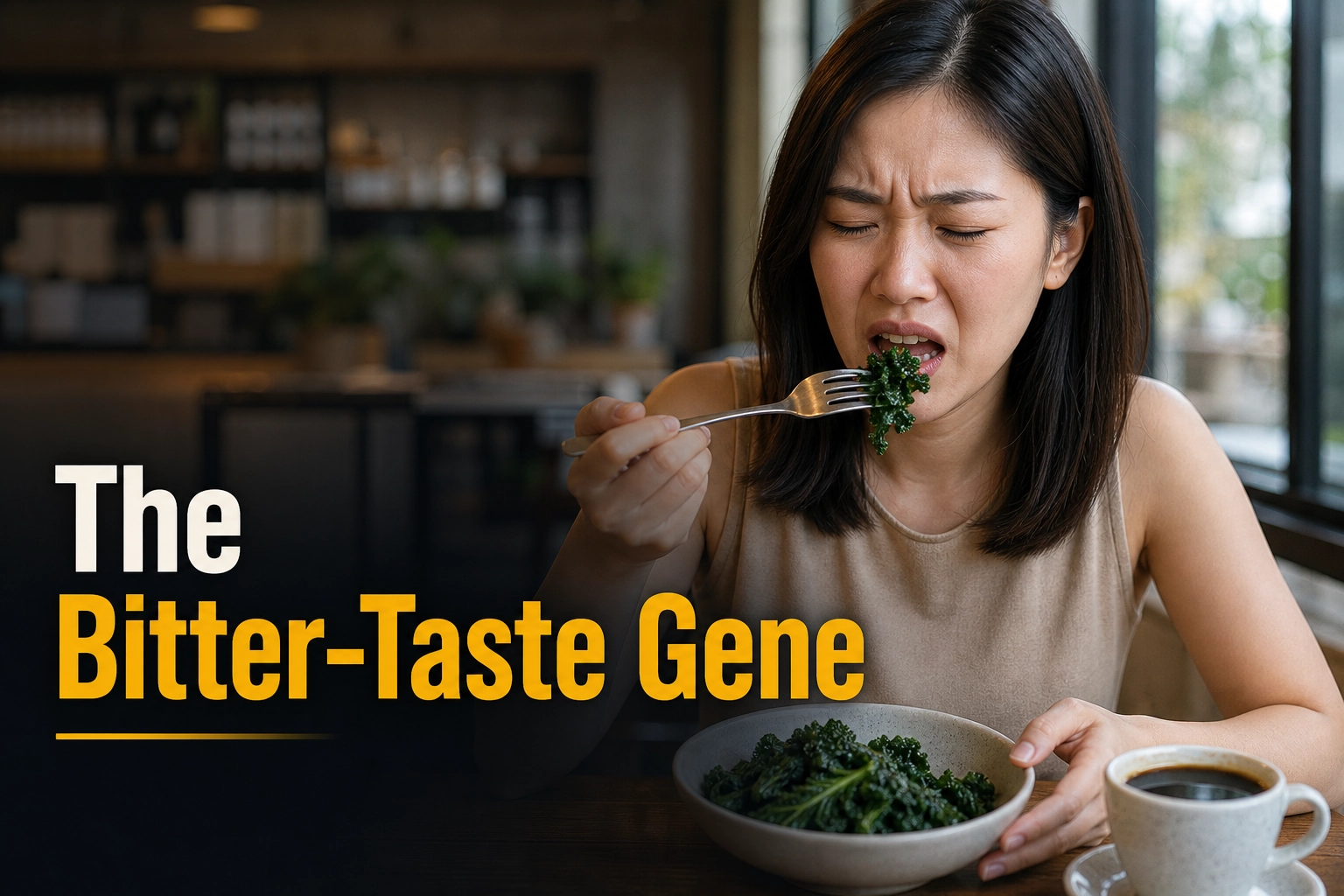
Why do some people find broccoli and coffee far more bitter than others? The answer hides in the TAS2R38 bitter-taste gene. Meet the supertasters and the fun, accurate science of vegetable preference.
Hello. I want to walk you through a fun topic that many people experience without realizing there is a genetic explanation behind it. Why can one person take a single bite of broccoli and wince at the bitterness, while another eats it happily as if there were no bitter taste at all? Part of the answer is hidden in a gene called TAS2R38. Let me explain it in a simple way while keeping the science accurate.
Your tongue carries many kinds of taste receptors. The TAS2R38 gene builds one particular bitter receptor that is especially sensitive to two chemicals researchers use in the lab: PTC (phenylthiocarbamide) and PROP (6-n-propylthiouracil). These compounds are structurally similar to glucosinolates, substances found naturally in cruciferous vegetables such as broccoli, kale, Brussels sprouts, and mustard greens.
This was discovered by accident back in 1931, when a chemist released PTC dust into the air and noticed some colleagues complained it was bitter while he tasted nothing at all. That moment launched the study of bitter-taste perception as an inherited trait.
The secret lies in just a few DNA differences (SNPs) in TAS2R38 that produce two main versions of the receptor protein, which scientists name after their amino acid sequence: PAV (the "taster" form that detects bitterness well) and AVI (the form that detects it poorly).
I should stress that the scientific meaning of "supertaster" is broader than TAS2R38 alone. It also involves the density of taste buds (fungiform papillae) on the tongue and other factors. Still, TAS2R38 is one of the clearest and most studied genetic pieces of the puzzle.
A common question is whether being sensitive to bitterness means you will also hate vegetables. Several studies have found an association between TAS2R38 genotype and eating behavior, especially in children. Those who are bitter-sensitive tend to eat fewer bitter leafy greens, and some studies find they lean toward sweeter foods.
That said, I would read this carefully, because:
If you are curious about how genetics shapes the flavors you perceive, take a look at our pieces on the gene that makes cilantro taste like soap and genetics and spice tolerance, two more examples of DNA shaping our eating experience.
To be fair to the evidence, let me spell out the limits clearly.
1. What is a supertaster?
A supertaster is someone more sensitive to bitterness (and partly to other tastes) than most people. This is linked in part to the PAV/PAV genotype of the TAS2R38 gene and to a higher density of taste buds on the tongue, which makes foods like broccoli or coffee taste more bitter than others perceive them.
2. If I carry a bitter-sensitive TAS2R38 variant, will I hate vegetables forever?
Not necessarily. The gene only raises a tendency; it is not destiny, especially in adults whose tastes shift with learning. Cooking methods such as roasting or pairing flavors reduce perceived bitterness and make vegetables easier to enjoy.
3. Does TAS2R38 explain all of coffee's bitterness?
No. TAS2R38 mainly detects PTC/PROP-type compounds, which are abundant in cruciferous vegetables. Coffee's bitterness comes from different compounds, and humans have more than 25 kinds of bitter receptors, so TAS2R38 explains only part of the picture.
4. Can a DNA test tell me if I am a supertaster?
Testing SNPs in TAS2R38 can indicate your bitter-taste tendency to some degree, but being a full supertaster also depends on other factors such as taste-bud count. Treat the result as one input for understanding yourself, not a fixed verdict.

