


 United States (USD)
 Singapore (SGD)
 African Country (USD)
 Australia (AUD)
 Canada (USD)
 Egypt (USD)
 European Country (EUR)
 Hong Kong (HKD)
 India (USD)
 Indonesia (IDR)
 Iran (USD)
 Iraq (USD)
 Japan (JPY)
 Myanmar (USD)
 Oman (USD)
 Philippines (USD)
 Qatar (USD)
 Saudi Arabia (USD)
 Switzerland (CHF)
 Taiwan (USD)
 Turkey (USD)
 UAE (USD)
 United Kingdom (GBP)
 International (USD)
Rated 4.98-stars across 4.8K+ reviews



 By
By
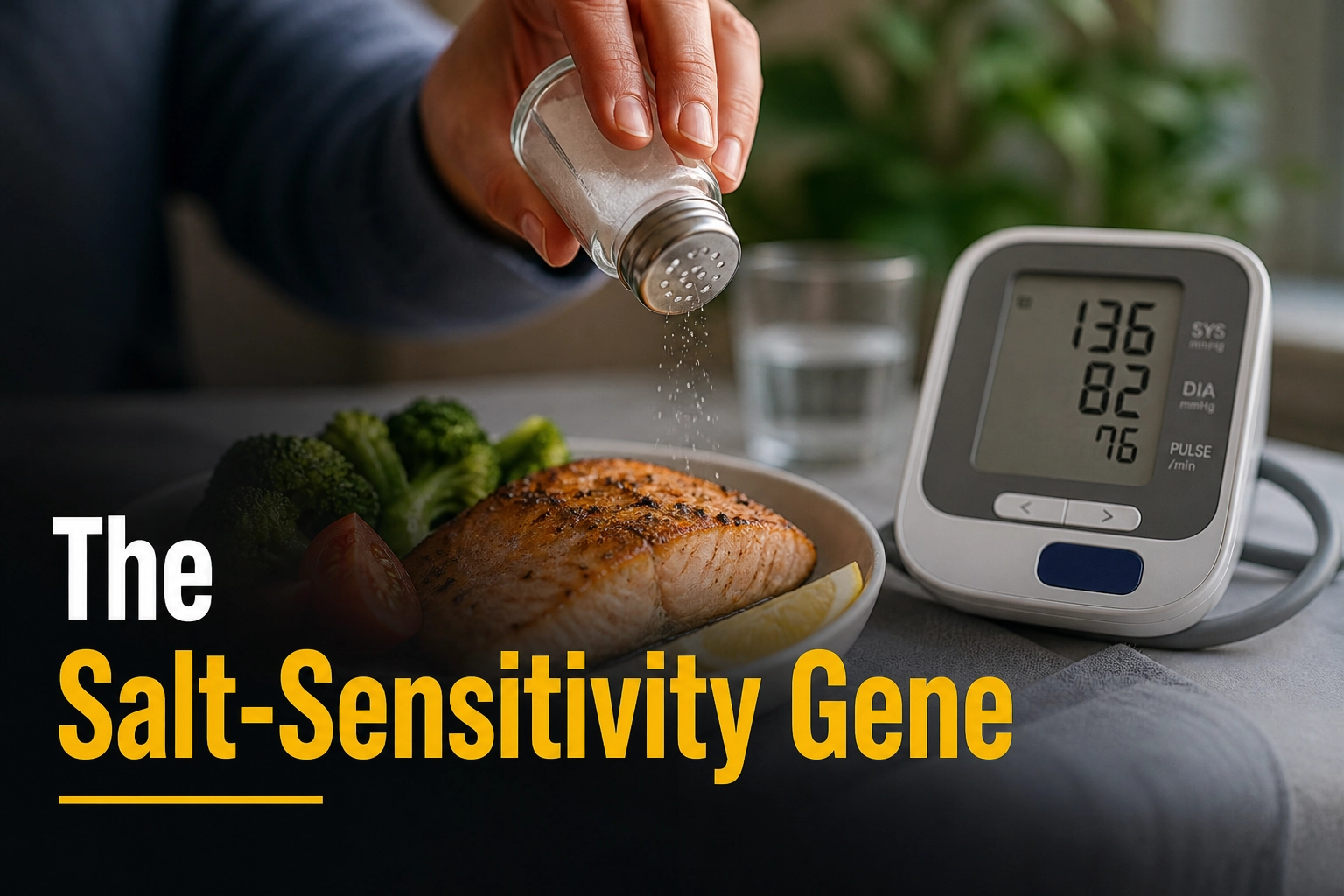
Some people's blood pressure jumps with salty food while others barely react. Part of the reason is salt sensitivity, where genetics plays a role. Here's a practical look at the RAAS genes and sodium handling.
Hello, and thanks for reading. As part of the Geneus DNA medical team, I often hear the same question: why can one friend eat spicy, salty food every day with normal blood pressure, while another feels puffy and sees their pressure climb after a single salty bowl of noodles? Part of the answer lies in a concept called salt sensitivity — and your genes help shape how well your body handles sodium. In this article I want to walk through it plainly, without alarm, and in a way you can actually use.
In general, when we eat more sodium, the body holds on to more water to keep blood concentration balanced. Blood volume rises and pressure tends to increase temporarily. In most people, the kidneys clear the excess sodium efficiently, so pressure barely changes. But in people with salt sensitivity, the kidneys excrete sodium more slowly or less completely, so blood pressure responds to salt much more visibly.
Research estimates that roughly one-quarter to one-half of adults have some degree of salt sensitivity. It becomes more common with age, and in people who are overweight or who have diabetes or kidney disease, and it also differs between ancestral groups. Importantly, it is a spectrum — not a simple black-and-white "yes or no."
The heart of sodium and blood-pressure control is a system called the RAAS (renin–angiotensin–aldosterone system), a hormone loop that governs both blood-vessel constriction and sodium reabsorption in the kidney. Roughly, it works like this:
When this loop is overactive or slow to switch off, the body tends to hold on to more sodium and water. That is exactly why several blood-pressure medications — such as ACE inhibitors and ARBs — act directly on this system.
Many genes have been studied in connection with salt sensitivity and blood pressure. Here are some that come up often, with the important caveat that each contributes only a small effect and must be read in context.
Keep in mind that common high blood pressure (essential hypertension) is a polygenic trait — the sum of many genes, each with a small effect, plus the environment. No single gene "decides" whether you are salt-sensitive. Reading this kind of genetic information is best treated as a tendency to help you plan self-care, rather than a diagnosis.
The encouraging part is that salt sensitivity responds well to behavior. Steps supported by human evidence include:
If you want to understand how food and your genes interact more broadly, read more about nutrigenomics. And if you're curious how genetics affects cardiovascular health from another angle, such as cholesterol, see our article on the APOE gene, cholesterol, and heart health.
To be fair to the evidence, let me underline several limitations:
1. Is salt sensitivity inherited?
There is a genuine genetic component. Genes in the RAAS system and kidney sodium transport are associated with salt sensitivity. However, it is a polygenic trait — many genes combined with the environment — so genetics indicates a tendency, not a verdict.
2. If a DNA test shows I'm salt-sensitive, do I have to give up salty food forever?
No extremes are needed. The goal is to bring sodium down to recommended levels (around 2,000 mg/day), add potassium-rich fruit and vegetables, manage your weight, and measure your blood pressure at home. Salt-sensitive people often benefit clearly from these adjustments.
3. How can I tell if I'm truly salt-sensitive?
The most direct way is to observe your own blood pressure when you eat more or less salt, by measuring regularly at home. Clinical confirmation requires controlled sodium intake under defined conditions. Genetic data is a helpful add-on but is not yet a precise individual predictor.
4. Do these blood-pressure genes relate to blood-pressure medications?
Several drug classes, such as ACE inhibitors and ARBs, act directly on the RAAS — the same system these genes involve. But medication choice is a decision for your doctor based on the whole picture; never adjust medication yourself based on a genetic result.

