


 United States (USD)
 Singapore (SGD)
 African Country (USD)
 Australia (AUD)
 Canada (USD)
 Egypt (USD)
 European Country (EUR)
 Hong Kong (HKD)
 India (USD)
 Indonesia (IDR)
 Iran (USD)
 Iraq (USD)
 Japan (JPY)
 Myanmar (USD)
 Oman (USD)
 Philippines (USD)
 Qatar (USD)
 Saudi Arabia (USD)
 Switzerland (CHF)
 Taiwan (USD)
 Turkey (USD)
 UAE (USD)
 United Kingdom (GBP)
 International (USD)
Rated 4.98-stars across 4.8K+ reviews



 By
By
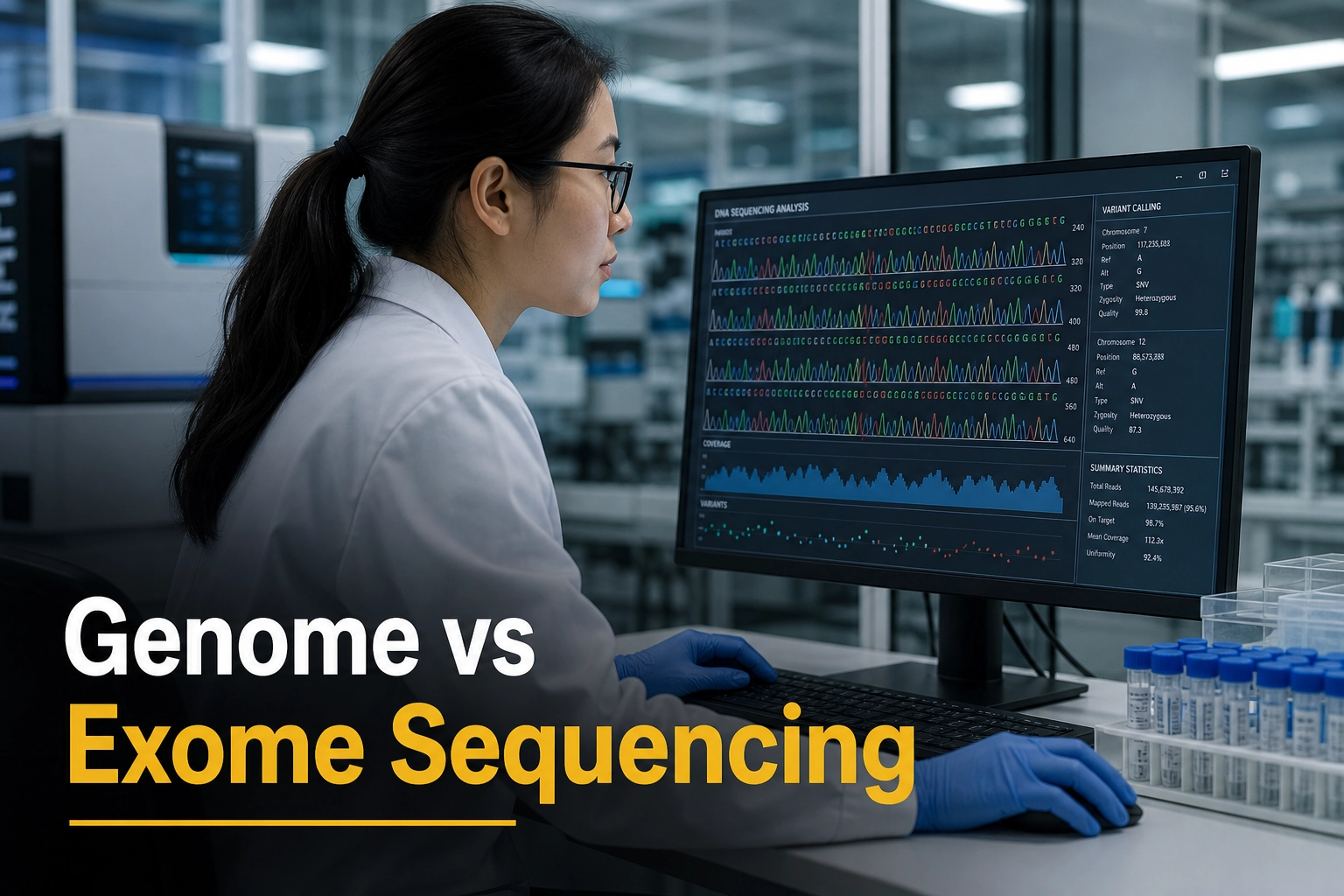
WGS reads nearly the entire genome, while WES targets only the protein-coding exome (~1-2%). Here is how they compare on scope, cost, depth, and when each is the right tool.
Hello, I am a physician who works with genetic data, and one question comes up again and again: "If I want a detailed DNA test, should I just sequence the whole genome, or is part of it enough?" There is no one-size-fits-all answer, because whole-genome and whole-exome sequencing were designed to answer different questions. In this article I will walk through what each technique actually reads, how they differ on cost and depth, and when one is the better fit.
The human genome contains roughly 3 billion base pairs, but the parts that are actually "translated into protein" are the exons, which together make up the exome — only about 1-2% of the whole genome. The rest is introns and intergenic regions that regulate genes or whose function is not yet fully understood.
The reason the exome matters far beyond its size is that most of the currently known Mendelian disease-causing variants fall within protein-coding regions. So reading the exome alone still captures a high proportion of clinically interpretable variants, while using far less data.
The core difference is the scope of what gets read.
Put simply, WES is like reading only the "key chapters" of a book, while WGS reads the whole thing — footnotes and the gaps between chapters included.
Cost and coverage are often mixed up, so let me separate them clearly.
In practice, the choice depends on the question you want answered.
Note that many ancestry or direct-to-consumer tests use a different class of technology (such as SNP genotyping arrays), which read only predefined positions rather than sequencing the entire exome or genome. If that interests you, see our article on ancestry DNA analysis.
What the science does not yet say is something I want to emphasize.
1. What is the main difference between WES and WGS?
WES reads only the exome, the protein-coding portion, which is about 1-2% of the genome, while WGS reads nearly the whole genome including introns and regulatory regions. WGS is therefore more comprehensive and better at detecting structural variation, but it carries higher cost and much larger data volume.
2. If I want to test for a genetic disease, which should I start with?
Many cases with a suspected Mendelian disease caused by a coding-gene variant begin with WES, because it is cost-effective and captures a high share of known disease-causing variants. If the result is negative but suspicion remains high, or the cause is expected outside coding regions, a clinician may consider WGS next. This decision should be made together with a clinician or genetic counselor.
3. Is WGS always more expensive?
Generally WGS still costs more per sample than WES, even though prices keep falling. Beyond the test itself, WGS also requires more storage and compute for analysis, so you should weigh the total cost, not just the sequencing fee.
4. Will a WGS test tell me everything about my health?
No. WGS reads broadly, but some regions remain hard to sequence and many variants cannot yet be interpreted clearly (VUS). Carrying a risk variant usually means a small, modifiable increase in risk, not a verdict, so results should always be interpreted with an expert.

