


 United States (USD)
 Singapore (SGD)
 African Country (USD)
 Australia (AUD)
 Canada (USD)
 Egypt (USD)
 European Country (EUR)
 Hong Kong (HKD)
 India (USD)
 Indonesia (IDR)
 Iran (USD)
 Iraq (USD)
 Japan (JPY)
 Myanmar (USD)
 Oman (USD)
 Philippines (USD)
 Qatar (USD)
 Saudi Arabia (USD)
 Switzerland (CHF)
 Taiwan (USD)
 Turkey (USD)
 UAE (USD)
 United Kingdom (GBP)
 International (USD)
Rated 4.98-stars across 4.8K+ reviews



 By
By
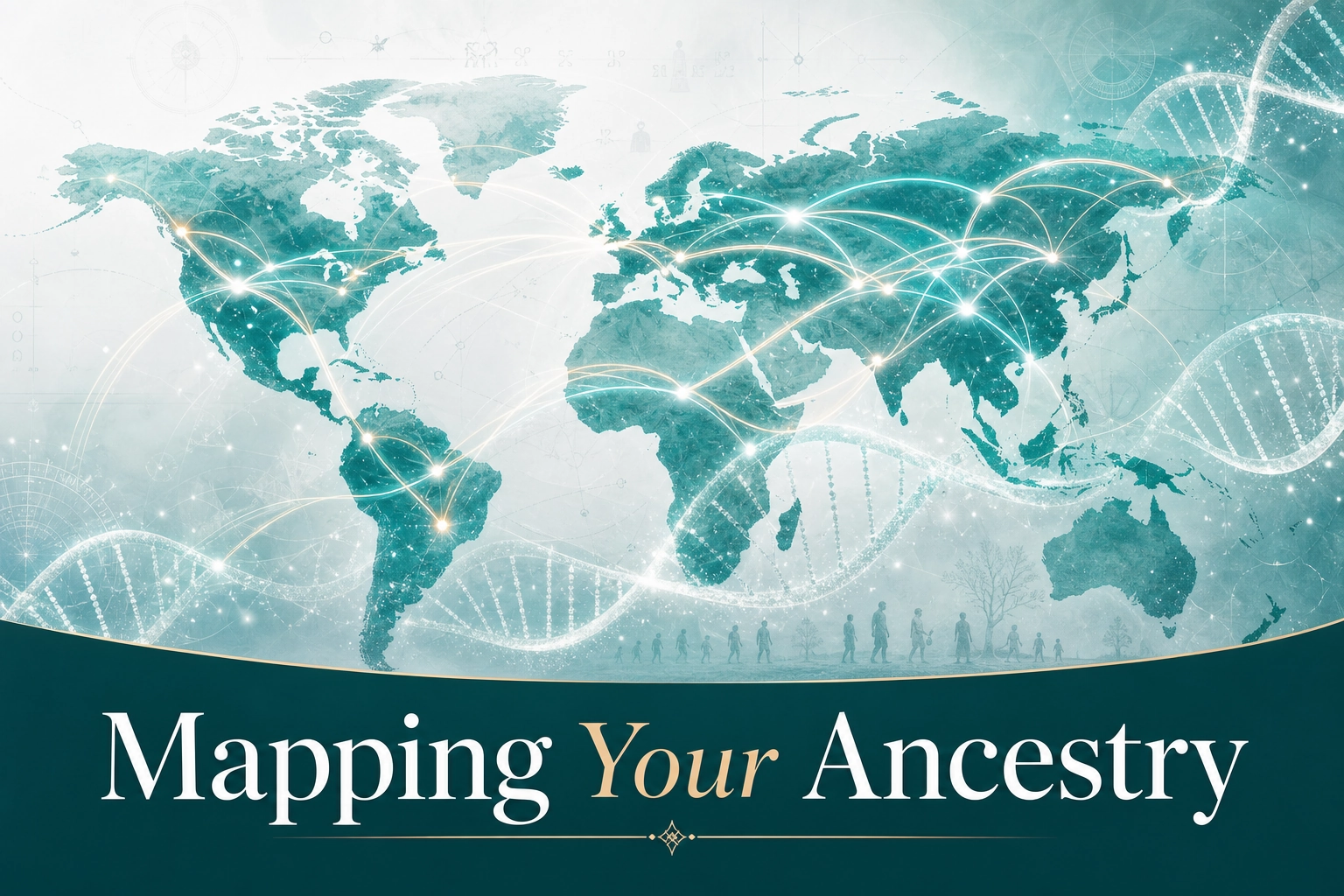
Ancestry testing doesn't find a "60% Thai" label inside your DNA. It's statistical inference from SNPs and haplogroups matched to global reference populations — rebuilding your ancestors' migration map.
People often imagine DNA carries a tag reading "60% Thai, 40% Chinese." The reality is far more intricate and fascinating. What actually happens is statistical inference: your genetic patterns are compared against populations whose origins we already know.
Modern chips read hundreds of thousands to millions of Single Nucleotide Polymorphisms (SNPs). The frequency of each SNP variant differs by region — these are the "signatures" of each population, and specialized sets called ancestry-informative markers (AIMs) are designed to tell populations apart.
Analyzing Y-chromosome DNA (paternal line) and mitochondrial DNA passed down the maternal line places you in a haplogroup — a group sharing a common ancestor, linked to ancient migration routes.
Algorithms (such as STRUCTURE, ADMIXTURE, and haplotype-based methods) split your genome into segments and ask which population each segment most resembles. Accuracy therefore depends on database quality — particularly the diversity of Southeast Asian population genetics, still underrepresented compared with European data.
Beyond the wonder of knowing your roots, ancestry data connects to population-specific disease risk and drug response. Understanding your genetic origins is foundational to precision medicine — and you can begin with the future of DNA-based wellness.
Every one of our genomes hides a record of humanity's journey across tens of thousands of years. Each additional Thai genome we read makes the genetic map of this region more complete. This isn't only about discovering your past — it's about building knowledge for the future of medicine across the whole region.
1. How accurate are ancestry results?
Not an exact number, but a highly accurate statistical inference — and it sharpens as databases grow.
2. Do I need to re-test as technology improves?
One test is enough — your DNA doesn't change — though results may gain detail as reference databases expand.
3. What is a haplogroup?
A haplogroup is a population sharing a distant common ancestor, used to trace migration lineages.

